Swatch Handed Everyone a Royal Oak and Watched What Happened Next
When a watch built on exclusivity gets a $400 version, the question was never about the watch.
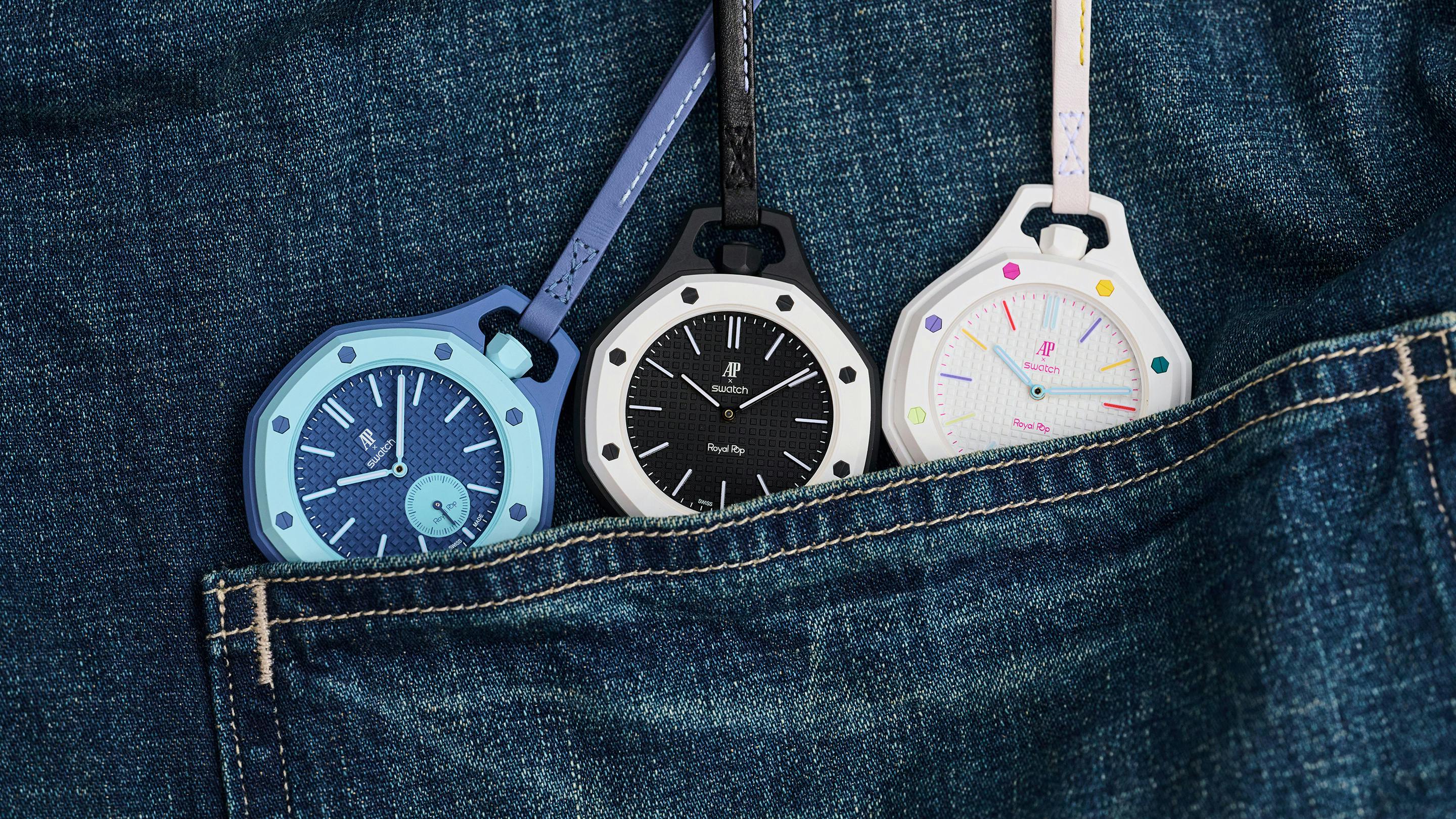
Photo · Hodinkee
Before the Drop
Somewhere in the weeks before May 16th, the internet started doing what the internet does — speculating, generating, leaking, catastrophizing. AI-produced images circulated as if they were inside intelligence. Social media, according to one podcast covering the chaos, went into what they called meltdown before anyone had confirmed a single detail. The watch hadn't been revealed yet. The lines hadn't formed. And already, the Royal Pop had become a kind of Rorschach test for what people believed about watchmaking, about access, about who gets to participate in something that used to feel exclusive.
That's the part worth sitting with. Not the watch. The reaction to the idea of the watch.
When Swatch and Audemars Piguet finally made it official — ahead of the planned May 16th announcement, because anticipation apparently had a shorter shelf life than either brand expected — what emerged was not a miniaturized Royal Oak for the wrist. It was something stranger and more deliberate. Eight pocket watches, worn on lanyards, rendered in Swatch's bioceramic material, in pop art colourways, carrying the unmistakable octagonal case shape that Gerald Genta put into the world. A new manually wound Sistem 51 movement, including one with small seconds, developed specifically to fit the pocket watch format. Starting at £335 in the UK, $400 in the US. Available at Swatch boutiques worldwide.
The watch world, as Time+Tide noted, was turned upside down. Robb Report called it a frenzy. Swisswatches Magazine asked the question directly in a headline — genius collab or collector's flop — and the fact that they had to ask tells you everything.
What It Actually Is
Let's be precise about the object, because the object keeps getting lost in the noise around it.
The Royal Pop is a pocket watch. Not a wrist watch with a strap swap. Not a Royal Oak shrunk to entry-level proportions. A pocket watch, on a lanyard, in a material that Swatch has developed and calls bioceramic — which one source described plainly as plastic — in colours that borrow from pop art rather than from the restrained metallic palette that made the Royal Oak's reputation. Revolution Watch made the point before release that this was never going to be a simple Royal Oak, and they were right in ways that probably cut deeper than intended.
The Royal Oak's octagonal case shape is there. The design language is legible. But the format, the material, the colour, the price, the distribution channel — all of it signals something different from the original. This is not a democratized Royal Oak. It's a collaboration that uses Royal Oak's iconography as raw material and builds something else entirely from it.
Which is either bold or revealing, depending on what you thought the Royal Oak was about in the first place.
The Question the Coverage Keeps Circling
Hodinkee went deep — hands-on impressions, live photos, the kind of thorough treatment they reserve for things that matter. SJX noted the new movement development with genuine interest. Multiple outlets tracked the price, the date, the boutique list. The coverage was thorough, largely enthusiastic, occasionally skeptical.
But almost none of it said the quiet thing clearly: if the Royal Oak's mystique was fundamentally about design, about Genta's audacity, about the engineering inside a case that redefined what a sports watch could be — then a $400 version in bioceramic and pop colours is a tribute. A conversation piece. Maybe even a clever one.
If the mystique was about scarcity, about the years-long waitlists, about belonging to the category of person who owns one — then this collaboration doesn't democratize anything. It just reveals what was always true. That the desire was never really about the object.
I keep coming back to this because it's the same question that surfaces every time something expensive gets a mass-market version. The MoonSwatch did it with the Speedmaster. The Royal Pop does it with the Royal Oak. And each time, the watch community splits almost perfectly along the line of what they believed the original was selling.
Who This Is For
The answer might be simpler than the discourse wants it to be.
The Royal Pop is a pocket watch on a lanyard in eight colours. It is for people who find that joyful. It will be worn to art fairs and music festivals and by people who have never thought about a movement in their lives and by collectors who will buy all eight and display them and by someone who genuinely just likes the yellow one. Swatch has always understood that watches don't have to be serious to be worth wearing. That's not a compromise. That's a design philosophy.
Audemars Piguet, for their part, lent their most recognizable shape to something that makes no pretense of competing with their actual watches. The octagonal case shows up. The name shows up. The price stays at Swatch territory. Whether that dilutes the original or simply proves the original is untouchable depends entirely on your prior beliefs.
What the Royal Pop does, finally and maybe accidentally, is force that question into the open. Every piece of coverage, every podcast episode, every frenzy and meltdown and hot take is just that question in different clothing: what were you actually buying, all along?
The watch is a pocket watch on a lanyard. The conversation is about something you've been carrying for years.
Keep reading fashion.

Gold Leaf on a Lacquer Dial, and the Weight of What That Costs
Awake's Frosted Leaf Royal Blue asks a question Vietnamese craft has never quite had to answer at this price.

Kyle Smith Has a Job Title That Didn't Exist Before. That's the Whole Tell.
When the NFL hires a fashion editor, it's not about clothes — it's about who gets to decide what matters.
525 Victories, One Dial, and Cycling's Long Wait for a Wrist
Breitling's Eddy Merckx edition doesn't just reference a legend — it asks whether motorsport's younger sibling has finally earned its place in serious watch culture.
From the other desks.

800 Horsepower, One Ton of Doubt
Lamborghini built the most powerful SUV it's ever made. It's also slower than what it replaced.

ESPN Named Him. Then Unnamed Him. Nobody's Explaining the Gap.
A retraction without a reckoning is just a deleted link.

Hide My Email Has Been Showing Your Email
Apple's privacy flagship has a hole in it. They've known for over a year.