The Watch Industry Keeps Asking for Permission. Louis Vuitton Just Stopped.
In a year full of incremental updates and safe steel sports watches, Louis Vuitton built something that looks like it escaped from a fever dream — and somehow that's the most refreshing thing I've seen on a wrist in years.
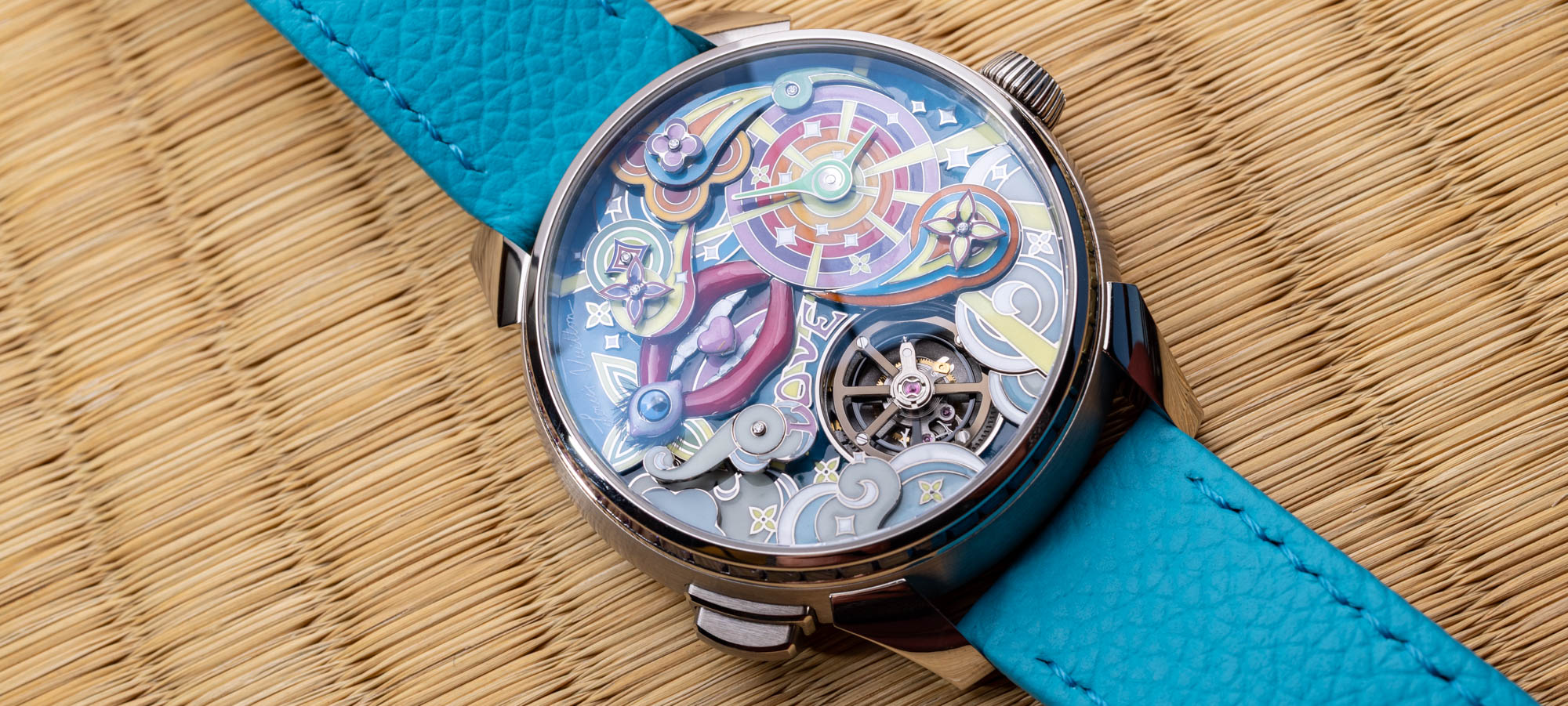
Photo · aBlogtoWatch
Nobody goes to Louis Vuitton for restraint. That's not an insult — it's the whole point. But the watch division has spent years trying to earn a seat at the serious horological table, chasing credibility with complications and movements and the kind of press that gets you framed on the wall of a collector's study. Understandable. Also, a little exhausting.
Then they made this.
The Thing Itself
The Tambour Taiko Arty Automata looks like someone handed a 1967 psychedelic poster artist a brief and then left the room for a decade. There are hand-painted visuals, animated figures, the kind of color combinations that don't ask for your approval. It references an era when weird was a feature, not a bug — when the goal was to make something that crackled with life rather than something that aged gracefully.
This watch does not age gracefully. It burns.
And here's the thing: that's a choice. A deliberate, confident, slightly unhinged choice made by people who knew exactly what they were doing. You can feel the conviction in it. The commitment to a visual language that has no interest in being universal.
What It's Actually Saying
Most of the watch industry right now is in a holding pattern. The references that moved markets five years ago are being reissued with slightly different dials. The independent scene is producing beautiful, serious objects that communicate primarily in the language of mechanical respect. All of it is fine. Some of it is genuinely great.
But almost none of it is surprising.
Surprise requires risk. Risk requires not knowing whether the audience will follow you. And the watch industry — even the parts that market themselves as bold — has become very good at calculated boldness. Edgy within parameters. Unconventional in ways that still photograph well on a gray gradient.
Louis Vuitton didn't do that here. This watch could alienate people. It probably will. The collector who spent thirty years building a serious collection of understated references is not the customer. That's fine. Not everything is for everyone, and the brands that try to be everything to everyone end up meaning nothing to anybody.
The Honesty in the Weird
There's a version of this piece where I interrogate the movement, debate the price, question the provenance. Whether Louis Vuitton has earned the right to make a complicated watch. Whether the maison belongs in the same conversation as the ateliers that have been doing this for a century.
I don't want to write that piece.
Because what strikes me about this watch isn't the mechanics — it's the self-awareness. Louis Vuitton knows what it is. It's a house built on the romance of travel, on the idea that beautiful objects should accompany a beautiful life, on color and craft and a certain unapologetic Frenchness. This watch isn't trying to be Patek. It's trying to be Louis Vuitton — fully, weirdly, without apology.
That kind of clarity is rarer than any complication.
What It Costs You
Not everyone can afford this watch. Not everyone should want it. But everyone paying attention to what's happening in the industry right now should look at it — really look at it — and ask why it feels so alive when so much else feels managed.
The answer isn't the price. It isn't the brand. It's that somebody, somewhere in that building, decided to make exactly the thing they wanted to make and trusted that the right people would find it.
That's the rarest movement in watchmaking right now. The willingness to mean something specific.