When the Art Actually Belongs There
Most art-edition watches are just paintings on a dial. The Ace Jewelers x Fears Brunswick 38 De Stijl is something rarer — a collaboration that understood the assignment.
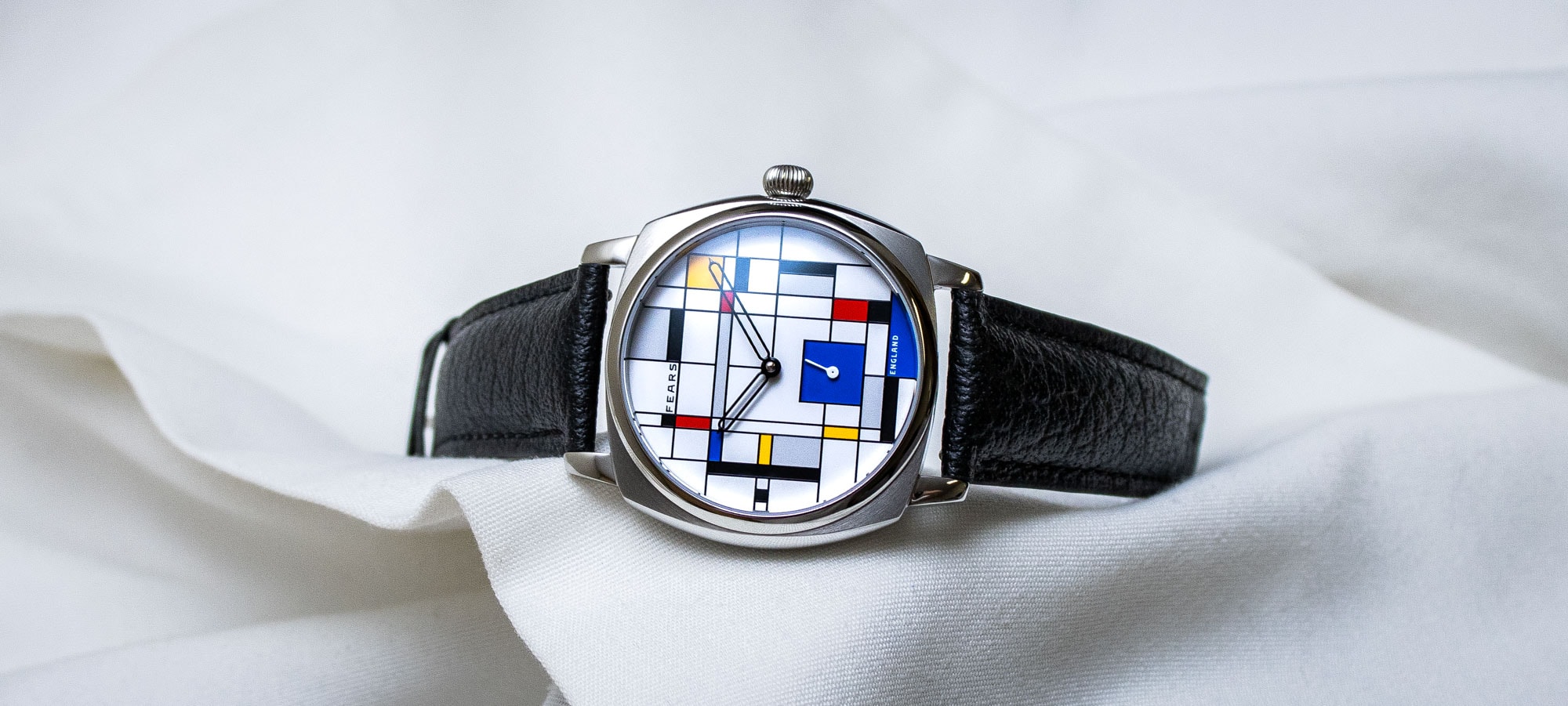
Photo · aBlogtoWatch
Most art-edition watches are souvenirs. You buy them the way you buy a print at the museum gift shop — not because the thing is great, but because you want to carry a piece of the feeling home. The art sits on top of the watch like a sticker. The watch sits underneath it, waiting to be a watch again.
The Ace Jewelers x Fears Brunswick 38 De Stijl Edition is not that.
The Problem With Art Watches
Here's what usually happens: a brand licenses an image, drops it on a dial, writes a press release about the artist's legacy, and calls it a collaboration. The result is a watch that exists in two worlds and belongs to neither. The art people don't trust it. The watch people don't need it. It sells to the overlap in the Venn diagram — people who want to signal both things at once — and then it disappears.
The reason it fails isn't the art. It's the translation. Nobody asked what the movement of a watch has in common with the movement of a painting. Nobody asked what a dial grid and a canvas grid share. Nobody asked whether the philosophy behind the art and the philosophy behind the object could actually speak to each other.
Someone asked those questions here.
De Stijl Isn't Decoration
De Stijl — the Dutch art movement that gave the world Mondrian's red-yellow-blue grids and Rietveld's chairs — was never about aesthetics. It was about reduction. The idea that if you strip everything to its essential geometry, you get closer to some universal truth underneath the noise. Horizontal. Vertical. Primary. Nothing extra.
Watches, at their best, operate on the same logic. A dial is a problem of information and space. The hands need to be readable. The indices need to anchor the eye. Everything else is a choice about what to remove. The best dials aren't decorated — they're resolved.
The Brunswick 38 was already a clean watch before this happened to it. Fears is a Bristol-based brand making cases and dials with a kind of quiet confidence — no shouting, no novelty for its own sake. The proportions are honest. Thirty-eight millimeters sits right. The case doesn't try to be more than it is.
What Ace Jewelers brought to it wasn't an image. It was a structural logic. The De Stijl geometry doesn't live on the dial the way a painting lives on a wall. It lives in the dial the way load-bearing walls live in a building — you feel the structure holding.
What It Actually Looks Like to Wear It
This is where most reviews lose the thread. They describe the watch. They don't describe the experience of the watch on a Tuesday.
A dial that references De Stijl is a dial that asks something of you every time you check the time. Not much — a flicker of recognition, a half-second where the geometry registers before the hour does. That's not a distraction. That's the thing working. The best dials do this. They give you the time and something else in the same glance.
The Brunswick 38 De Stijl Edition is a 38mm watch, which means it fits under a cuff without announcing itself. It means it reads as personal rather than performative. You're not wearing this to be seen wearing it. You're wearing it because it satisfies something — some instinct toward things that are thought-through.
The people who notice it will know why they noticed it. The people who don't won't be bothered by it. That's the right radius for a watch like this.
Why This One Works
Collaborations fail when they're additive — when the logic is watch plus art equals watch-art. They work when they're integrative — when the art and the object are asking the same question from different directions.
Fears and Ace Jewelers found a movement — De Stijl — built on the same obsession that makes a great watch dial great: what happens when you remove everything that isn't essential? The answer, in both cases, is that what's left becomes more itself. More present. More true.
That's not a museum gift shop impulse. That's a watch that earns the conversation it starts.