Roger Goodell Had Answers Ready. That Was the Problem.
When the commissioner of the NFL finally faces a hard question, watch what he does with it.
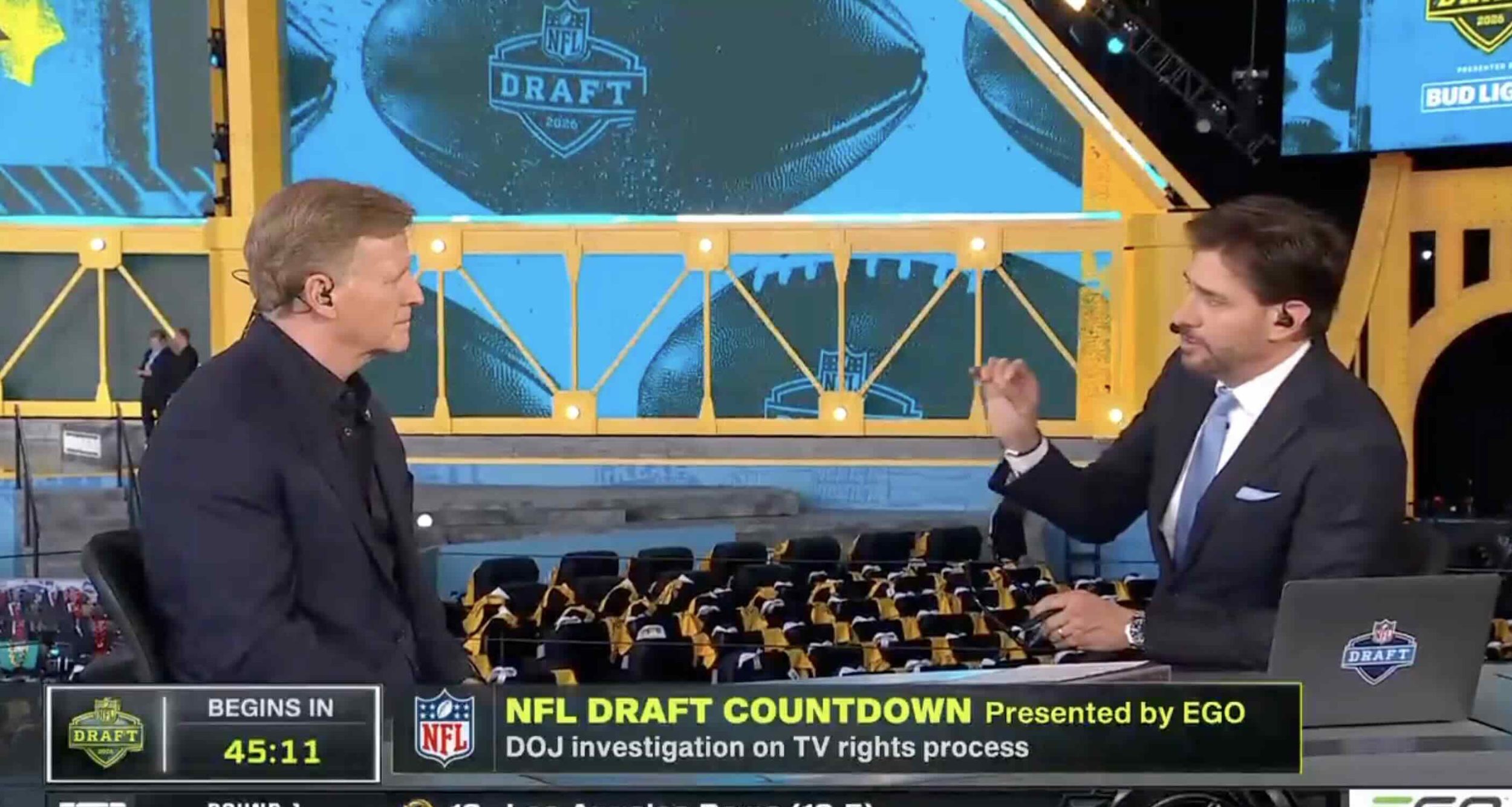
Photo · Awful Announcing
Before the First Pick
There's a version of the NFL Draft interview where Roger Goodell sits across from a host, says something warm about the kids about to hear their names called, and everyone moves on. That's the usual arrangement. Comfortable, pre-negotiated, mutually beneficial.
Thursday wasn't quite that.
According to Awful Announcing, ESPN's Mike Greenberg and the network's coverage team actually pressed Goodell — notably on the Justice Department's investigation into whether the NFL's television rights deals comply with the Sports Broadcasting Act of 1961. That law grants professional sports leagues an antitrust exemption to negotiate broadcast packages collectively, on behalf of all their teams. It is, in plain terms, the legal scaffolding the entire NFL television business is built on. And right now, the DOJ is asking whether the league has been honoring its terms as live sports increasingly migrate from broadcast television to streaming.
Goodell's response, per Awful Announcing's coverage: the NFL is the most accessible game out there.
Read that again.
The Justice Department is investigating whether a league is abusing an antitrust exemption written into federal law, and the commissioner's answer is a positioning statement. Not a legal defense. Not a factual rebuttal. A tagline.
What Deflection Sounds Like at Scale
To be fair to Goodell, he is not going to litigate a federal investigation on the ESPN set during Draft coverage. Nobody expected that. But there's a difference between declining to comment and deploying a marketing phrase in place of substance. One is professional discretion. The other is something else.
The Sports Broadcasting Act of 1961 exists because Congress decided that letting a league negotiate TV deals as a single entity — rather than having 32 teams compete against each other for broadcast partners — served the public interest. Broader access was the implicit bargain. The antitrust exemption was the trade. And now, as streaming fragments the audience and puts more games behind subscription walls, the DOJ is asking whether the NFL has held up its end.
That's a serious question. Serious enough that the Justice Department is asking it. Serious enough that it came up in a Draft interview, which — as Awful Announcing noted — is not typically where notable insights emerge. The fact that it surfaced at all, in that setting, with Greenberg actually pushing on it, tells you something about the moment the league finds itself in.
Goodell has managed the NFL through labor disputes, domestic violence scandals, head injury litigation, and a pandemic. He is not a man easily rattled. But "most accessible game out there" is not a man engaging with the question. It's a man buying time in front of a camera, fluently, with the practiced ease of someone who has done it for years.
The accessibility argument might even be partially true. It doesn't answer what the DOJ is asking.
The Pressure Underneath
What both pieces from Awful Announcing capture — without quite saying it directly — is that something has shifted. The NFL's relationship with its broadcast partners, with regulators, and with the press is no longer frictionless. The antitrust exemption that makes the entire television rights structure possible is under scrutiny. And the commissioner got asked about it on live television before a single player's name was called.
That's not nothing. For years, NFL Draft coverage has been a controlled environment — celebratory, forward-looking, carefully staged. Thursday had some of that. But it also had a federal investigation sitting in the room.
Goodell's deflection didn't close the story. It confirmed there's one worth following.
Keep reading sports.

ESPN Named Him. Then Unnamed Him. Nobody's Explaining the Gap.
A retraction without a reckoning is just a deleted link.

Three People Died Celebrating. FIFA Hasn't Said Their Names.
Mexico City buried three people after the World Cup crowds came through. At some point, the sport has to sit with that.

Sell the Stadium, Lose the Room
NFL franchises are rolling out the welcome mat for World Cup tourists — and the desperation is showing.
From the other desks.

800 Horsepower, One Ton of Doubt
Lamborghini built the most powerful SUV it's ever made. It's also slower than what it replaced.

Gold Leaf on a Lacquer Dial, and the Weight of What That Costs
Awake's Frosted Leaf Royal Blue asks a question Vietnamese craft has never quite had to answer at this price.

Hide My Email Has Been Showing Your Email
Apple's privacy flagship has a hole in it. They've known for over a year.