All of Humanity in One Frame, and He Drove Home in a Beetle
The man who photographed every person who ever lived chose the most unassuming car on Earth — and maybe that tells us more about him than the moon did.
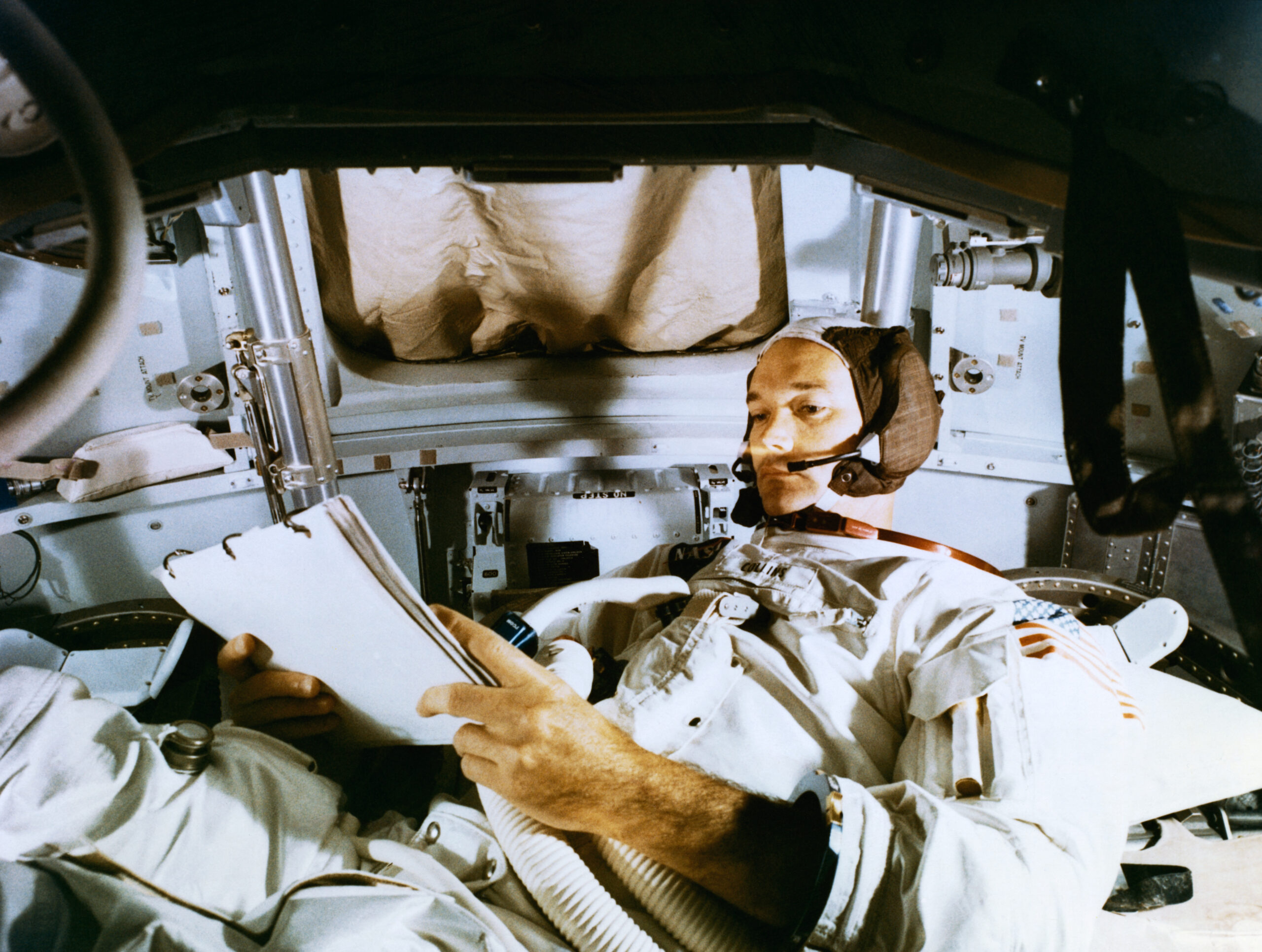
Photo · Hagerty Media
The Photograph Nobody Talks About
On July 21, 1969, Michael Collins pointed a Hasselblad camera out of a window and took a picture that contained, by one remarkable accounting, every human being who had ever lived or ever died — with the exception of himself. The Eagle lander, the lunar surface, the Earth hanging above it all. Everyone. Everywhere. Except the man holding the camera.
We know the astronauts who walked. We forget the one who waited. Collins orbited alone while Armstrong and Aldrin descended, and for stretches of that orbit he passed behind the moon, out of radio contact with Earth entirely — a silence more complete than anything most of us will ever know. The mission logs exist. The photograph exists. What we don't talk about enough is what came after, when the capsule splashed down and the parades finished and the world moved on to the next thing.
He drove a Volkswagen Beetle.
A writer at Hagerty Media recently staked out this detail as something worth paying attention to — and they're right. Not because the Beetle is a remarkable car. Because the man who photographed all of humanity chose the least remarkable car he could find, and that choice has been sitting there quietly for decades, waiting for someone to notice what it means.
The Weight of the Obvious
Here's what strikes me about this story being told now, in this particular moment: we are living through an era of maximalism in automotive culture. The trucks are enormous. The horsepower figures are obscene. The infotainment screens span dashboard to dashboard. Every car wants to announce something about the person inside it. Status. Taste. Net worth. Ambition. Even the understated choices are increasingly performed understatement — the kind of thing that costs more than the flashy alternative and is designed to be recognized by people who know.
And then there's this. A man who had literally been to the edge of the known world, who had looked back at everything that exists and fit it inside a single camera frame, who had experienced a solitude so profound it probably doesn't translate into any language we have — and he came home and drove a Beetle. The car that, at the time, was synonymous with a certain cheerful ordinariness. Practical. Honest. Utterly without pretension.
You can read that as humility, or you can read it as something sharper: a man who had seen the actual scale of things, and who understood, with more clarity than most of us will ever manage, that the car in the driveway is just a car.
What Groundedness Actually Costs
I keep coming back to this because I think we misunderstand what authenticity looks like in practice. We want it to be dramatic. We want the man who orbited the moon to do something grand with his life afterward — to build something, to declare something, to perform his transformation for us. Instead, the Hagerty piece finds him at the level of the driveway. Ordinary transportation. No statement.
That's actually harder than it sounds. Achievement, especially achievement of that magnitude, creates enormous pressure to keep achieving at that register — or at minimum to signal that you understand how significant the previous achievement was. The car you drive becomes part of the autobiography. People expect the story to continue at the same altitude.
Collins apparently didn't play along. And there's something in that refusal — or maybe it wasn't even a refusal, maybe it was just a man who wanted a car that ran — that cuts against everything the current moment is trying to sell us about aspiration and identity and the objects we surround ourselves with.
The Loneliest Frame
What the Hagerty writer has really done, whether they intended to or not, is give us a small meditation on scale. Collins took the photograph. Collins contained all of us in it. And then Collins came back down and lived a life, with a car that asked nothing of anyone.
There's a version of this story that ends with a moral about humility or simplicity, and I'm not interested in writing that version. The Beetle isn't a symbol. It's just a car. But the gap between what Collins had seen and what he chose to drive home in — that gap is interesting. That gap is the whole thing.
Most of us will never have a reference point that extreme. We haven't looked back at Earth from the far side of the moon. We don't know what it does to a person's sense of proportion. But the question the Hagerty piece leaves sitting in the room is one I can't shake loose: if you had seen everything, from that far away, what would you drive home in? And more to the point — would you even need it to mean anything?
Some people look at the universe and come back wanting more. Collins, apparently, came back wanting a Beetle. I find that more interesting than almost anything else about the mission.
Keep reading cars.

800 Horsepower, One Ton of Doubt
Lamborghini built the most powerful SUV it's ever made. It's also slower than what it replaced.

£11,990 Draws a Line Under Every Excuse You Had Left
Dacia just made the cheapest new car in Britain electric — and that's not a footnote, it's a verdict.

Blanc Éternel Hides Its Speed Behind a Gas Cap
Bugatti built a 261-mph roadster and made sure you'd notice the porcelain first.
From the other desks.

Gold Leaf on a Lacquer Dial, and the Weight of What That Costs
Awake's Frosted Leaf Royal Blue asks a question Vietnamese craft has never quite had to answer at this price.

ESPN Named Him. Then Unnamed Him. Nobody's Explaining the Gap.
A retraction without a reckoning is just a deleted link.

Hide My Email Has Been Showing Your Email
Apple's privacy flagship has a hole in it. They've known for over a year.