Rolex Blinked First, and It Was Beautiful
The most conservative name in watchmaking just put six colors on its most foundational dial — and somehow, it's not a contradiction.
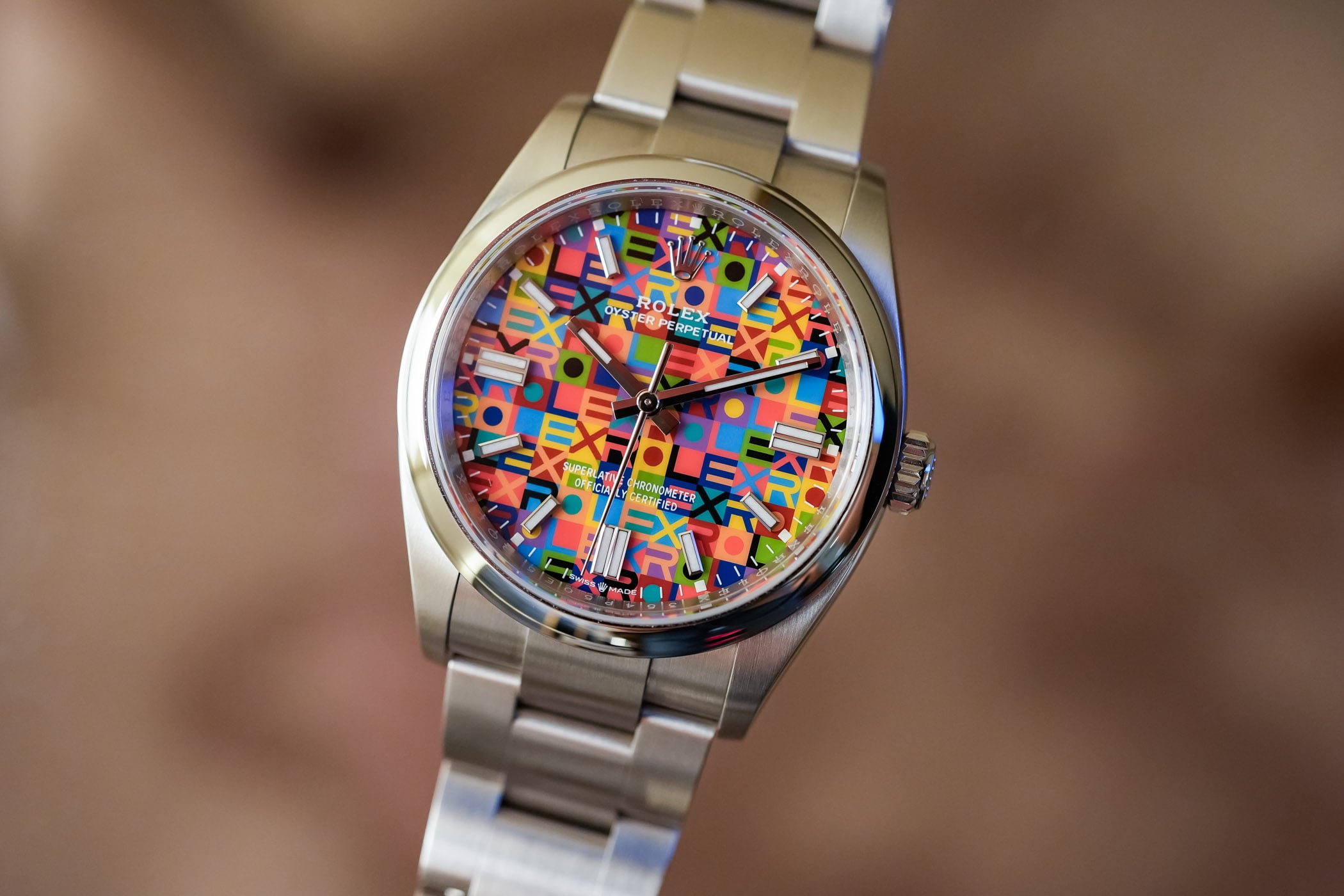
Photo · Monochrome Watches
There's a version of Rolex that never changes. That's the version most people carry in their heads — the Oyster Perpetual as institutional object, as inherited heirloom, as the watch you wear to signal that you've stopped needing to signal anything. Austere. Correct. Deliberately, almost stubbornly, restrained.
Then the brand marks the centenary of its Oyster case by covering a dial in six colors and calling it Jubilee. And suddenly you have to reconsider what the institution was actually telling you all along.
What They Put On It
The Oyster Perpetual 36 is the baseline — time-only, 36mm, the watch that traces its lineage back to one of the earliest waterproof wristwatches ever made. It is not a complicated watch. It was never meant to be. Its entire argument is legibility, durability, and the kind of quiet permanence that makes other watches feel like they're trying too hard.
The new dial keeps the architecture intact. What changes is everything inside it. SJX described it as polychrome — multiple colors distributed across the dial in a way that reads less like an accident and more like a considered decision someone at the brand had been sitting on for a while. Monochrome Watches noted that this is a watch that doesn't require you to be a watchmaking obsessive to understand its place in the landscape. That observation matters more than it seems. Rolex didn't make this dial for collectors parsing movement finishing. They made it for people who feel things when they look at something.
And that's the confession.
What the Color Actually Says
Every brand has a face it shows the world and a face it shows when nobody's watching. For Rolex, the public face has always been discipline — the tool watch made right, the dress watch made sensibly, nothing chasing a trend it didn't start. The Jubilee dial is what happens when that discipline decides, just once, to exhale.
SJX put it plainly: this variant will likely appeal to experienced collectors and to people who've historically found the brand too sedate. That's a wide net. Deliberately wide. Because what Rolex is doing here isn't abandoning its identity — it's expanding who gets to feel included in it. The polychrome dial is an invitation written in a language the brand rarely uses.
There's something worth sitting with in the timing. A centenary is a permission slip. It lets a brand do something it might not otherwise justify — not a revision, not a new direction, just a moment of color against a hundred years of seriousness. Temporary license dressed as celebration. Except the watch is real, the dial is permanent, and the people who buy it will wear it for decades.
So maybe it isn't temporary at all. Maybe this is Rolex noticing that restraint, taken too far, starts to look like fear.
The Oyster Perpetual 36 in polychrome Jubilee doesn't abandon what the watch has always been. It just admits that being timeless and being joyful were never mutually exclusive — and that somewhere inside the most conservative name in the room, someone always knew that.
Permission to be playful is harder to grant than permission to be serious. Rolex just granted it to itself.
Keep reading fashion.

Gold Leaf on a Lacquer Dial, and the Weight of What That Costs
Awake's Frosted Leaf Royal Blue asks a question Vietnamese craft has never quite had to answer at this price.

Kyle Smith Has a Job Title That Didn't Exist Before. That's the Whole Tell.
When the NFL hires a fashion editor, it's not about clothes — it's about who gets to decide what matters.

525 Victories, One Dial, and Cycling's Long Wait for a Wrist
Breitling's Eddy Merckx edition doesn't just reference a legend — it asks whether motorsport's younger sibling has finally earned its place in serious watch culture.
From the other desks.

800 Horsepower, One Ton of Doubt
Lamborghini built the most powerful SUV it's ever made. It's also slower than what it replaced.

ESPN Named Him. Then Unnamed Him. Nobody's Explaining the Gap.
A retraction without a reckoning is just a deleted link.

Hide My Email Has Been Showing Your Email
Apple's privacy flagship has a hole in it. They've known for over a year.