Super Bowl XXVII Stopped. Bob Costas Still Hears It.
A writer at Andscape just argued that a halftime show from over thirty years ago was America talking to itself. They're not wrong.
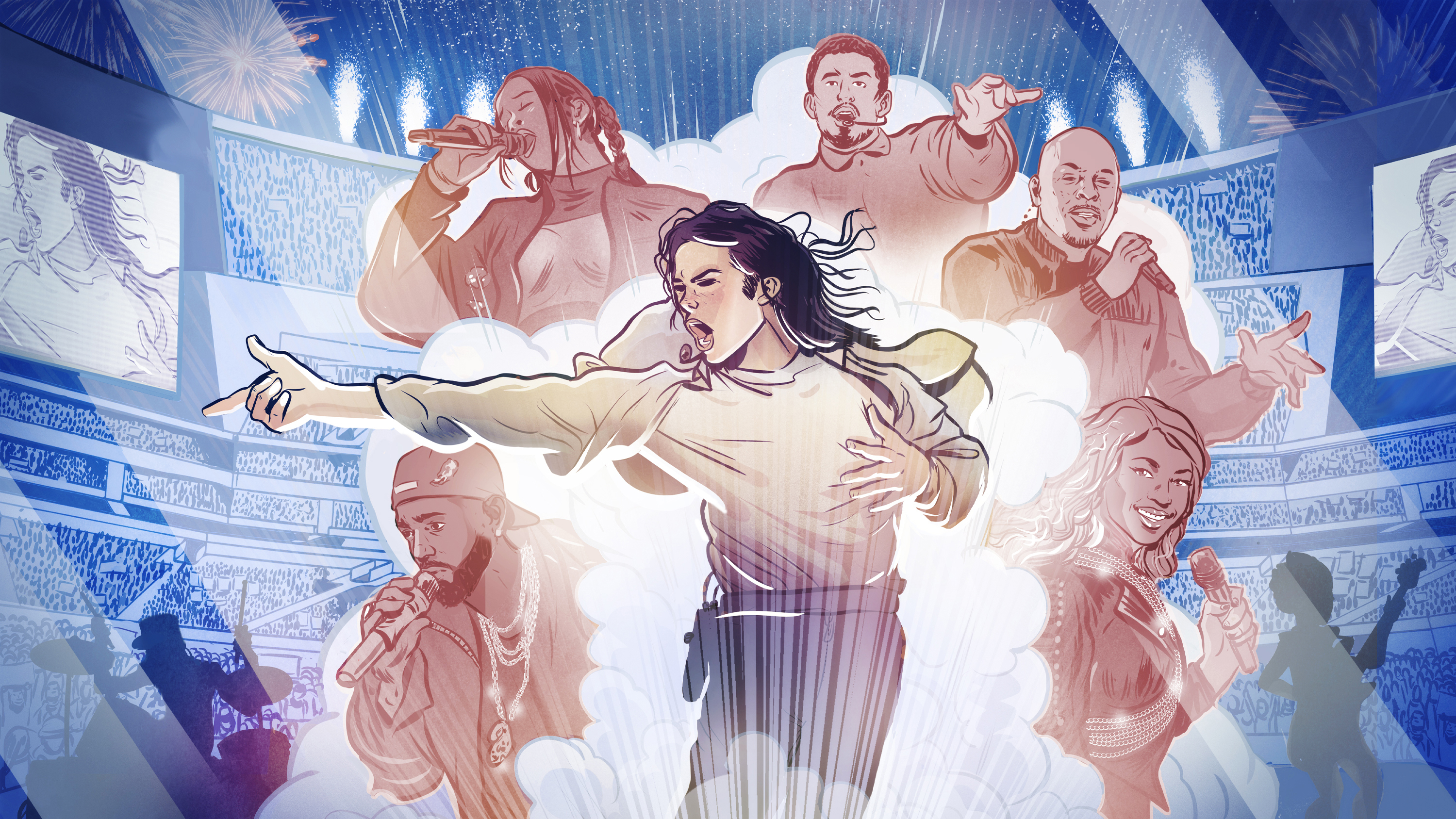
Photo · Andscape
What Stays With You
There's a version of this where we're just talking about a pop star standing still for ninety seconds while sixty-seven thousand people lost their minds. Stadium lights cut. A figure rises from beneath the stage. The crowd waits. Nobody breathes. Then the whole thing detonates.
That moment — Michael Jackson, Super Bowl XXVII — happened more than thirty years ago. Bob Costas, according to a writer at Andscape, can still hear the instructions that preceded it. That detail is the one I keep turning over. Not the performance itself, but what it means that a seasoned broadcaster carries the memory of a production meeting the way other people carry the memory of the performance. Because that's the tell. That's where you find out something was different.
Andscape has been running a series called The American Carnival — a full-year examination of the Super Bowl halftime show as a cultural object. Not entertainment. A cultural object. The distinction matters. Entertainment is something you consume and forget. A cultural object is something that does work on you whether you agreed to it or not. The series is asking whether twelve minutes on the most-watched stage in America sometimes says more about the country than the football game wrapped around it. The piece on Jackson's 1993 performance is their answer in the affirmative.
I think they're onto something. I think they're onto something bigger than they're saying directly.
The Confession Dressed as a Concert
Here's what I mean. The Super Bowl halftime show in 1992 — the year before Jackson — was a salute to the Winter Olympics. Marching bands. Safe. Invisible. The kind of thing that fills time without making demands. The NFL, facing declining halftime ratings and the threat of viewers changing the channel, made a decision to bring in someone who could hold the room. They chose Jackson.
What they got was something they probably didn't fully anticipate: a performer who understood that the room was the whole country, and that the whole country was in the middle of something. America in 1993 was not a settled place. It was loud with unresolved things. Jackson stood still for over a minute at the top of that show — just stood there, letting the crowd's energy build until it had nowhere to go but out — and in that stillness, he made the audience reveal itself. Sixty-seven thousand people screaming at a man for simply existing on a stage. That's not a concert moment. That's a confession.
The Andscape writer frames the performance as the night the Super Bowl stood still. I'd go further. It's the night the Super Bowl became the place where America's discomfort with race, with fame, with Black excellence at a scale too large to contain, got performed in public under the guise of halftime entertainment. Jackson didn't just fill the space. He expanded it. He made the stage mean something it hadn't meant before.
And the NFL let him. That's the part nobody talks about.
What the Series Is Really Asking
The American Carnival as a project is doing something quietly ambitious. It's arguing that the halftime show is a primary document — not a footnote to American culture but evidence of it. That if you want to understand what this country was negotiating with itself in any given year, you could do worse than watching twelve minutes of choreography and spectacle and see what made it onto that stage, and why, and what the crowd did with it.
That's a serious argument. And Jackson's 1993 performance is the strongest possible opening exhibit, because it happened at a hinge moment — before the accusations that would redefine his public life, when he was still the clearest possible symbol of what Black artistry could achieve at maximum volume. The NFL, an institution not historically known for progressive cultural instincts, handed him the biggest stage in American sports and told him to go. What he did with it was his. What it revealed was ours.
I find myself thinking about what it costs to be that visible. To be the proof of something that a country needs proven, and to carry that need on your body, in your performance, every time you step into a room. Jackson stood still for ninety seconds and the crowd screamed. That's not about a song. That's about what he represented to people who needed something to believe in, and what he represented to people who were threatened by that belief.
The writer at Andscape is asking us to look at the halftime show as a mirror. The reflection in 1993 was complicated. It still is.
What Gets Carried Forward
The reason this piece lands now — the reason The American Carnival as a series makes sense as a project — is that we're still asking the same questions. Every year, the halftime show generates a conversation that has nothing to do with music and everything to do with who gets to be enormous in America, and on whose terms, and what it costs.
Bob Costas remembers the instructions. The crowd remembers the ninety seconds of silence before the explosion. The NFL remembers the ratings. And somewhere underneath all of it is the actual performance — a man, a stage, an entire country watching — and the question of what we were really seeing when we thought we were just watching a show.
That question doesn't have an expiration date.
Keep reading sports.

ESPN Named Him. Then Unnamed Him. Nobody's Explaining the Gap.
A retraction without a reckoning is just a deleted link.

Three People Died Celebrating. FIFA Hasn't Said Their Names.
Mexico City buried three people after the World Cup crowds came through. At some point, the sport has to sit with that.

Sell the Stadium, Lose the Room
NFL franchises are rolling out the welcome mat for World Cup tourists — and the desperation is showing.
From the other desks.

800 Horsepower, One Ton of Doubt
Lamborghini built the most powerful SUV it's ever made. It's also slower than what it replaced.

Gold Leaf on a Lacquer Dial, and the Weight of What That Costs
Awake's Frosted Leaf Royal Blue asks a question Vietnamese craft has never quite had to answer at this price.

Hide My Email Has Been Showing Your Email
Apple's privacy flagship has a hole in it. They've known for over a year.