One Man Dribbling. Four Men Watching. Two Series Proving It.
The Knicks keep handing Jalen Brunson the ball and stepping back. The Nuggets-Wolves keep proving what happens when they don't.
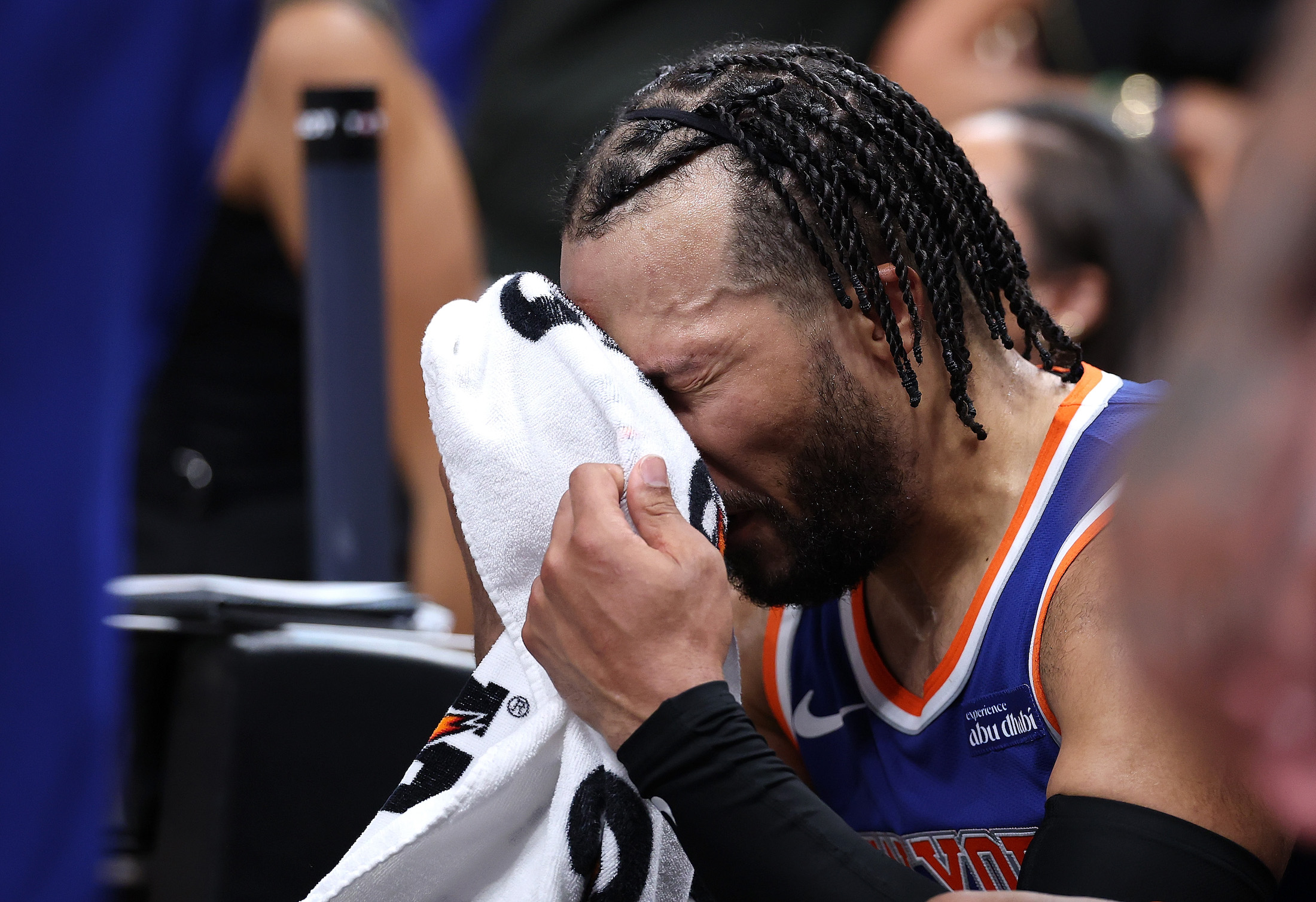
Photo · Defector
There's a moment in every close Knicks playoff game where you can feel it coming. The offense slows, the spacing collapses inward, and everyone on the floor — everyone in the building, maybe — understands what's about to happen. The tiny man is going to dribble. Alone. Until something breaks.
In Game 3 against the Hawks, what broke was the game. A Jalen Brunson airball on one final possession, a Jalen Brunson turnover on another, and a one-point loss — the second consecutive one-point loss — to close out the night. A writer at Defector described it with a precision that stings: basketball reduced, in those final moments, to a solitary little fella bouncing the ball indefinitely until he has no choice but to fling it toward the hoop.
That's not a knock on Brunson specifically. He's genuinely remarkable. But the system — if you can call it that — is the confession. The Knicks, in crunch time, have decided that isolation is the answer. Star power over structure. One man over five.
What the Wolves Are Doing Instead
Three time zones west, a different story was playing out Thursday night. Minnesota dominated Game 3 against Denver, and the texture of it couldn't be more different from what New York was running. The Nuggets-Timberwolves series, now three games into its third playoff meeting in four years, has developed into something the NBA almost never produces anymore: a real rivalry, with real edges.
Another Defector piece described the current state of NBA rivalries as arid — a parched climate bred by player empowerment, AAU culture, the parity era, the internet's anti-geographic flattening of fandom. Most rivalries are nostalgic fictions at this point. But Nuggets-Wolves is the live exception, two teams that are stylistic and temperamental opposites, who genuinely seem to dislike each other, generating what the piece called reliably great theater and occasionally great basketball.
Jaden McDaniels, as the second piece's headline makes plain, will fight you every step of the way. That's not metaphor. It's a disposition — a team disposition, built into how Minnesota competes. It's collaborative aggression. It's the opposite of everyone standing around watching one guy try to create something from nothing.
The Real Confession
Here's what both series are telling us at the same time: the NBA has quietly made peace with a contradiction it used to resist. The league spent years evangelizing ball movement, system basketball, the death of isolation. The analytics revolution was supposed to bury the hero-ball instinct under a pile of corner threes and second-side cuts. And it worked, right up until the moment a playoff game got tight and the coach called timeout.
Because when it matters most — when the margin is one possession, when the crowd is loud and the defense is locked in — teams keep going back to the star. Hand him the ball. Clear out. Pray.
The Knicks aren't an outlier. They're just the most visible version of a truth the league keeps pretending isn't true: at the end of games, NBA basketball is still a star's game. Systems exist to generate advantages that one extraordinary player then exploits. And when the system fails to generate that advantage — or when the coach doesn't trust it — you get isolation. You get everyone standing still while one man decides the outcome alone.
The Nuggets-Wolves series is compelling precisely because both teams resist that gravitational pull better than most. They fight each other for every inch. The spite is structural.
New York lost by one. Twice. Maybe that's bad luck. Maybe that's what happens when you ask one man to carry more weight than any ball was designed to hold.
Keep reading sports.

ESPN Named Him. Then Unnamed Him. Nobody's Explaining the Gap.
A retraction without a reckoning is just a deleted link.

Three People Died Celebrating. FIFA Hasn't Said Their Names.
Mexico City buried three people after the World Cup crowds came through. At some point, the sport has to sit with that.

Sell the Stadium, Lose the Room
NFL franchises are rolling out the welcome mat for World Cup tourists — and the desperation is showing.
From the other desks.

800 Horsepower, One Ton of Doubt
Lamborghini built the most powerful SUV it's ever made. It's also slower than what it replaced.

Gold Leaf on a Lacquer Dial, and the Weight of What That Costs
Awake's Frosted Leaf Royal Blue asks a question Vietnamese craft has never quite had to answer at this price.

Hide My Email Has Been Showing Your Email
Apple's privacy flagship has a hole in it. They've known for over a year.