Las Vegas Let Athletes Dope Openly. Nobody Broke Much.
The Enhanced Games promised to shatter what human performance means. What it delivered was a controversy about a stopwatch.
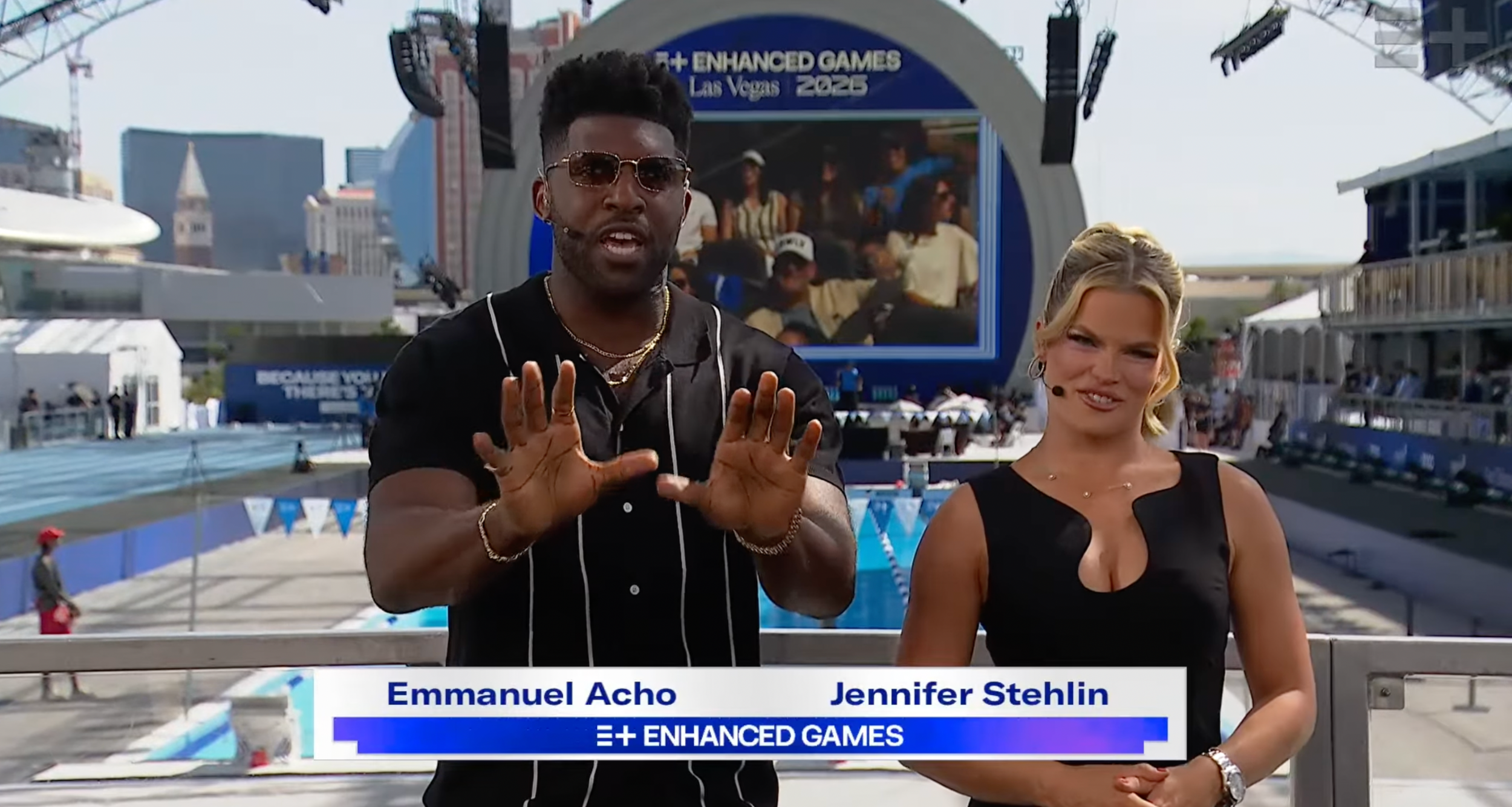
Photo · Awful Announcing
Here is what the Enhanced Games asked you to believe: that removing every drug restriction from elite sport would produce something so extreme, so record-shattering, that the whole architecture of clean competition would look quaint by comparison. Las Vegas. Drugs. No limits. The future of human performance, live.
What it delivered, according to one outlet covering the debut, was a major flop.
The Spectacle Didn't Show Up
Of the 42 athletes who competed across swimming and sprinting, the event managed to generate one headline moment — and that moment immediately became a controversy. Greek swimmer Kristian Gkolomeev posted a time of 20.81 seconds in the men's 50m freestyle, which the Enhanced Games declared a world record. Then the internet noticed something: in footage of the swim, Gkolomeev appeared to touch the wall after his time had already appeared on screen.
The Enhanced Games called the questions "completely unfounded internet drivel." Whether the timing was accurate or not, the fact that the organization's biggest talking point from their inaugural event required a public defense of their own stopwatch tells you something about how the weekend went.
But here's what's strange about the coverage: Emmanuel Acho, as reported by Awful Announcing, defended the Enhanced Games as a win — for athletes, for audiences, for the concept itself. He wasn't alone in thinking the premise had merit. And that split in reaction is more interesting than the event itself.
Two Audiences, One Event
The people who wanted the Enhanced Games to fail were always going to find evidence that it did. The people who wanted it to succeed — who are genuinely curious what happens when you remove the pharmacological ceiling — were always going to defend it.
What neither camp seems to fully reckon with is that the Enhanced Games was never really about science. It was about spectacle. And spectacle has a specific requirement: it has to actually be spectacular.
If you're going to build an event on the premise that athletes can take whatever they want and push human performance past anything we've seen, you need the performances to be visibly, undeniably extraordinary. You need numbers that make people put their phones down. What the Enhanced Games got instead was a disputed record, a defensive press statement, and the kind of media coverage that treats "flop" as the most accurate available word.
The market the Enhanced Games is trying to create — audiences who don't care whether the records are real, only that they're extreme — does exist. Fringe sport has always found its crowd. But that crowd requires a certain level of theater to stay interested. A timing dispute isn't theater. It's bureaucracy.
Acho's defense, as covered by Awful Announcing, is understandable in one sense: the concept is genuinely novel, and first editions of anything are rough. But novelty doesn't hold a crowd on its own. The X Games were novel. They also had people flying off ramps at speeds that made you gasp. The Enhanced Games' opening act didn't produce that gasp.
What it produced was a question about a stopwatch.
That's not the end of the story — organizations survive bad debuts all the time. But the Enhanced Games has a harder problem than bad optics. It made a promise about the outer edge of human capability, and the outer edge didn't show up. Until it does, calling the skeptics "internet drivel" is just noise trying to sound like confidence.
Keep reading sports.

ESPN Named Him. Then Unnamed Him. Nobody's Explaining the Gap.
A retraction without a reckoning is just a deleted link.

Three People Died Celebrating. FIFA Hasn't Said Their Names.
Mexico City buried three people after the World Cup crowds came through. At some point, the sport has to sit with that.

Sell the Stadium, Lose the Room
NFL franchises are rolling out the welcome mat for World Cup tourists — and the desperation is showing.
From the other desks.

800 Horsepower, One Ton of Doubt
Lamborghini built the most powerful SUV it's ever made. It's also slower than what it replaced.

Gold Leaf on a Lacquer Dial, and the Weight of What That Costs
Awake's Frosted Leaf Royal Blue asks a question Vietnamese craft has never quite had to answer at this price.

Hide My Email Has Been Showing Your Email
Apple's privacy flagship has a hole in it. They've known for over a year.