New York Has Been Waiting 27 Years to Feel Like This. Read the Room.
The Knicks are in the Finals, the city is losing its mind, and every faction has a different reason why this moment belongs to them.
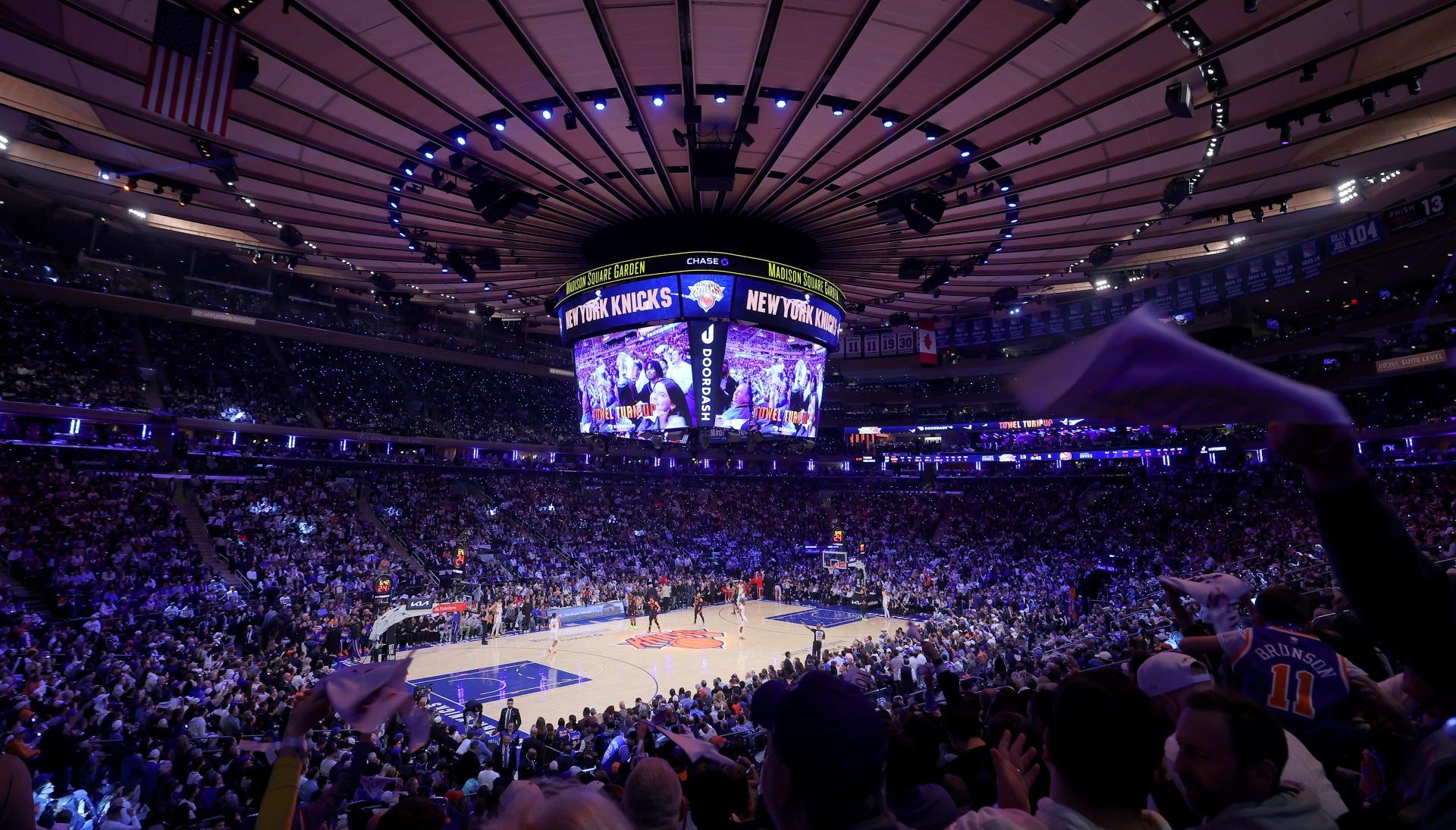
Photo · Front Office Sports
The City That Owns Everything, Starved for One Thing
Somewhere on Rikers Island, in the common area of a housing unit inside the George R. Vierno Center, nearly 2,000 incarcerated people watched Game 1 of the NBA Finals. They dragged plastic chairs toward flat-screen televisions. They piled a folding table with snacks. They argued calls. They roasted celebrity fans. And from somewhere in that space, according to a Guardian report, a refrain cut through the noise — Knicks in four — with the particular confidence of people who have been waiting a very long time for New York to give them something.
That image stays with me. Not because it's surprising that people inside Rikers care about basketball. Because it's clarifying. Strip away the $8,000 get-in prices, strip away the Abu Dhabi jersey patch, strip away the sitting president and the owner angling for a redemption narrative — and what's left is a city that hasn't been to an NBA Finals since 1999, finally exhaling. Twenty-seven years is a long time to hold your breath.
The coverage swirling around this Knicks run is voluminous and fractured, each piece pulling at a different thread of the same fraying cloth. But read them together and a single, uncomfortable truth surfaces: New York's joy is real, and nearly everyone surrounding it is trying to own a piece of it they didn't earn.
Walt Frazier's Hands
Andscape found Walt Frazier in San Antonio, holding out both fists — a ring on his left hand for being named one of the NBA's top fifty players of all time, a ring on his right from the 1973 championship. The last time the Knicks won it all. He has been the franchise's living memory for half a century, its patriarch, the man who was great when greatness was the expectation rather than the prayer.
Frazier's presence in the coverage isn't incidental. It's the story beneath the story. What does it mean that the man most associated with Knicks excellence is now a symbol of how long excellence has been absent? He isn't a bridge to a dynasty. He is, at this point, proof that the dynasty was real — that it existed, once, that New York basketball was something.
This is the emotional architecture of a 27-year drought. You don't just miss winning. You start to wonder if you imagined it.
And now, suddenly, Jalen Brunson. A roster that believes in itself. A city that has been handed permission — real permission, competitive permission — to care again.
Who Gets to Claim This
Here's where it gets complicated.
Front Office Sports reported that Knicks get-in prices for Game 3 at Madison Square Garden hit $8,000 and were still climbing — outpacing both the Super Bowl and the World Cup. That number is worth sitting with. The fans who filled those Rikers common areas, who have been loyal through the lean decades in ways that $8,000 floor tickets cannot buy, are watching on screens. The people paying to be in the building are, at those prices, a self-selected group that skews heavily toward people for whom $8,000 is inconvenient rather than impossible. The crowd in the arena and the crowd in the city are not the same crowd.
Then there's the jersey. Sportico noted that the Knicks' Finals uniforms carry a patch on the upper left corner instructing fans to Experience Abu Dhabi — a sovereign fund sponsorship that has become common in global sports, though its timing has collided with U.S. government friction over the arrangement. The detail matters not because jersey patches are new, but because of what it communicates visually: at the exact moment New York is trying to reclaim something deeply local and long-denied, the uniform is carrying an advertisement for somewhere else.
And then there's Dolan. Sportico reported that a segment of New York's media class has been circulating what the piece characterized as a redemption arc narrative around the Knicks' owner — and that Knicks fans are, with some force, rejecting it. The logic is straightforward: James Dolan did not become a different owner. The team became good despite the conditions he created, not because of them. Joy and credit are not the same thing, and this city knows the difference.
Then there's the presidential dimension. According to the Guardian, Donald Trump — a self-described longtime Knicks fan — said he plans to attend a Finals game at MSG, at the invitation of Dolan, in what the NBA believes would mark the first time a sitting president has attended an NBA Finals. New York City mayoral candidate Zohran Mamdani was also expected at Game 3. The arena, for at least one night, would hold a sitting president and his most prominent local political opponent, wrapped in Knicks orange and blue, in front of a sold-out crowd paying four figures minimum to be there.
The whole of New York, as the Guardian put it, is stressed right now.
What Wemby Has to Do With All of It
The other half of this Finals is Victor Wembanyama, the Spurs' 22-year-old, 7-foot-4 center, who Andscape described as a generational talent in only his third NBA season. Boardroom called this the Finals the league needed — Wembanyama's coming-out party against New York's lightning-in-a-bottle window. The league's future versus the league's most storied market, finally restored to relevance.
That framing is clean and it's also slightly too convenient. The NBA didn't manufacture this. Brunson and his teammates earned it. Wembanyama earned it. But the league is not wrong that the matchup is remarkable — two franchises, two completely different kinds of hunger, meeting at a moment when professional basketball badly needed proof that it could still produce a Finals worth watching from anywhere, not just from courtside.
I keep thinking about the men on Rikers. Not as a symbol, but as a fact. The Finals reached a jail complex on an island in the East River, where people with no ticket and no jersey and no $8,000 to spend dragged plastic chairs across a floor and argued calls and shared in something. New York gave them that. Twenty-seven years late, but it gave them that.
Somebody will win this series. What happens to the city's exhale after that is a different question entirely.
Keep reading sports.

ESPN Named Him. Then Unnamed Him. Nobody's Explaining the Gap.
A retraction without a reckoning is just a deleted link.

Three People Died Celebrating. FIFA Hasn't Said Their Names.
Mexico City buried three people after the World Cup crowds came through. At some point, the sport has to sit with that.

Sell the Stadium, Lose the Room
NFL franchises are rolling out the welcome mat for World Cup tourists — and the desperation is showing.
From the other desks.

800 Horsepower, One Ton of Doubt
Lamborghini built the most powerful SUV it's ever made. It's also slower than what it replaced.

Gold Leaf on a Lacquer Dial, and the Weight of What That Costs
Awake's Frosted Leaf Royal Blue asks a question Vietnamese craft has never quite had to answer at this price.

Hide My Email Has Been Showing Your Email
Apple's privacy flagship has a hole in it. They've known for over a year.