Red Car, Right Moment, Wrong Question
Everyone wanted to know if Lewis Hamilton could still win. Nobody asked what winning would mean.
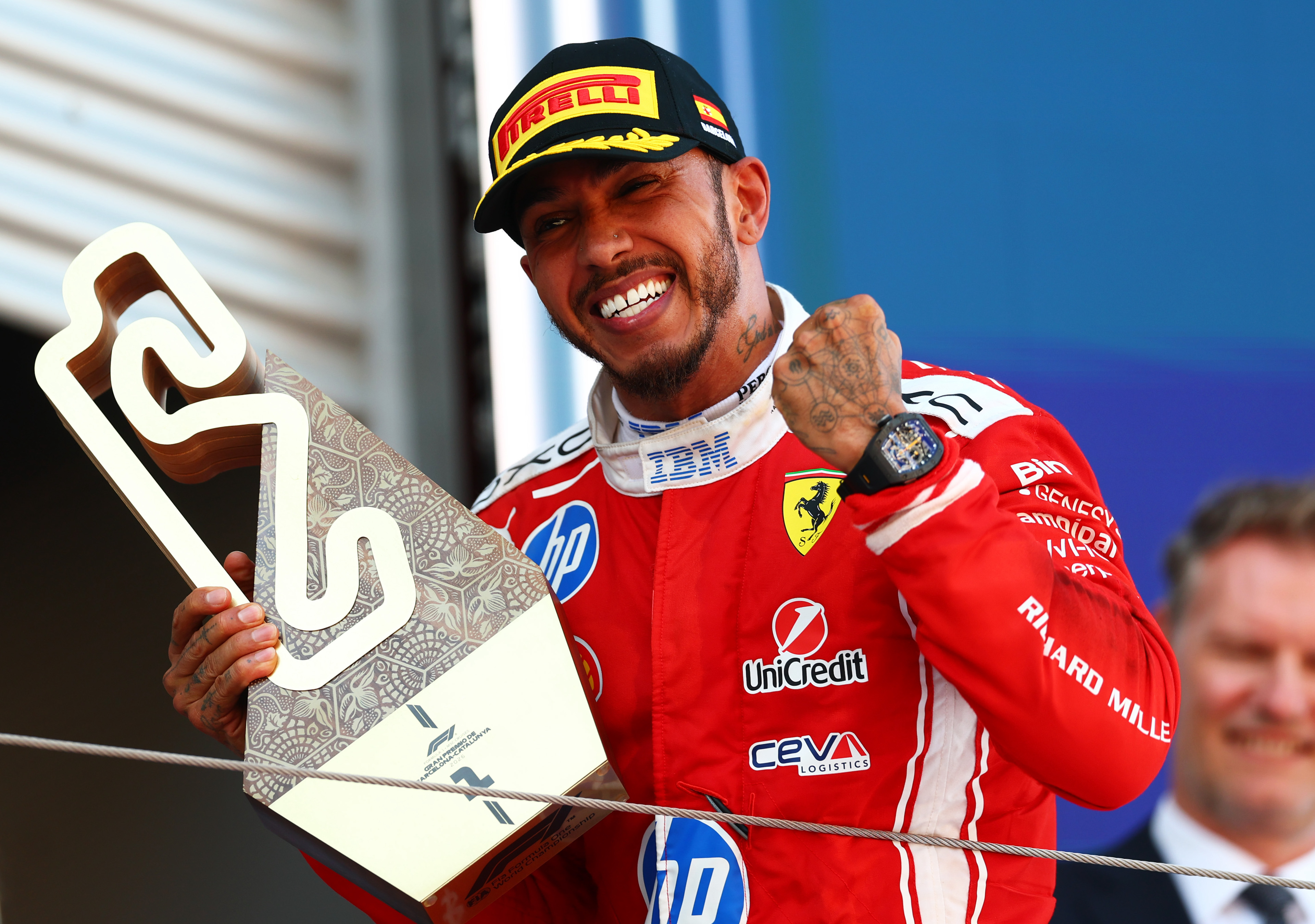
Photo · Defector
The Scoreboard Doesn't Know What to Do With This
Picture the stat line for a moment. One hundred and six race wins. Seven championships. Nineteen years in Formula One. And now, at 41, a first win for Ferrari at the Circuit de Barcelona-Catalunya — making Hamilton one of the oldest race winners in the sport's history. The numbers pile up until they stop making sense, until they become more monument than measurement, the kind of career data that statisticians and obituary writers keep on standby.
But here's what the spreadsheet misses: the numbers don't tell you how the thing felt. They don't tell you whether it meant anything, or whether meaning is even the right frame for a Sunday afternoon in Barcelona.
The Defector called the win "frighteningly" something — the full word cut off in transmission, which is its own kind of poetry — contrasting it with Hamilton's previous victory, described as a wet-weather classic at Silverstone nearly two years prior. A miracle. A frantic masterclass at his home race. Barcelona, apparently, was different. Cleaner. More controlled. The suggestion being that this win wasn't rescued from chaos — it was constructed from competence. Which, depending on your temperament, is either more impressive or less romantic.
The Guardian framed it as a question: is Hamilton genuinely a contender for an eighth championship? It's the right journalistic instinct. It's also, I think, the wrong emotional one.
What Redemption Looks Like Under Fluorescent Light
There's a version of the Lewis Hamilton Ferrari story that writes itself like a film. The greatest driver of his generation, restless after years of dominance with one team, makes the move everyone called impulsive. He shows up in red. He learns a new car, a new culture, a new set of engineers who don't yet know his rhythms. And then, one Sunday, he wins. The music swells. Credits roll.
Except sports don't work like films. The credits don't roll. The next race is already scheduled.
The Guardian notes that Kimi Antonelli — a name that signals youth the way only an F1 grid can, quietly and at high velocity — still stands between Hamilton and a title. The championship question, asked aloud, immediately introduces the machinery of competition: points gaps, reliability records, team strategies, how many races remain. The romantic arc runs directly into the bureaucratic reality of a 24-race season, and the bureaucracy doesn't care about narrative.
This is what I keep returning to. We want reinvention stories to have clean endings. We want the late-career move to be vindicated by a trophy, the risk to be retroactively obvious. But Hamilton at 41, winning in Barcelona, is not the ending of a story. It's one data point in an ongoing argument — between what he was, what he is, and what a sport built on milliseconds will ultimately allow him to become.
A Contender, Among the Elite
The Guardian, to its credit, doesn't oversell the moment. It acknowledges the "soaring emotions" while immediately pivoting to the harder question. It describes Hamilton's display as "consummate" and confirms he "remains among the elite drivers on the grid" — which is both genuinely impressive and faintly hedged. Among the elite. Not the fastest. Not the favorite. Among.
That word carries weight. It's the word you use when someone has proven they belong at the table without quite proving they'll take the meal. And at 41, in his first season with a new constructor, in a sport where the gap between elite and champion can be measured in tenths of a second across a thousand kilometers, "among the elite" is simultaneously high praise and a quiet ceiling.
The Defector's framing is more interested in the texture of the thing — in stripping away the legacy-building and looking at the race itself, the Sunday afternoon, the laps as they happened. That instinct feels right to me. Because the legacy is already written. The seven championships exist. The 106 wins exist. Whatever Hamilton does from here adds to the monument, but it doesn't rewrite it.
What Barcelona offered was something rarer: proof that the instinct is still live. That the decision-making in traffic, the tire management, the feel for a car that isn't yet fully his — all of it still functions at the highest level. That's not nothing. In a sport that discards drivers with brutal efficiency, it's actually extraordinary.
The Question We Should Be Asking
Here's what both sources, together, suggest without quite stating: we've been asking the wrong thing about Lewis Hamilton at Ferrari.
The question "can he win a championship?" is really a question about outcome. It's forward-facing, measurable, binary. Either he does or he doesn't. And there's nothing wrong with that question — it's the question the sport runs on.
But the question underneath it, the one that Barcelona made briefly visible before the next race weekend swallowed it whole, is harder. It's the question about what it means to still want something this badly at 41, to make a move that no algorithm would recommend, to show up to a new garage and new engineers and a new car and say: I think I can do this.
Most people — in any field, at any level — stop asking that of themselves long before 41. They settle into competence. They protect what they've built. They stop taking the kind of risks that could embarrass them.
Hamilton, whatever happens with the championship, has not done that. Barcelona proved it wasn't nostalgia driving him across the garage. Something in him still reaches.
I don't know what to do with that, exactly. But I think about it.
Keep reading sports.

ESPN Named Him. Then Unnamed Him. Nobody's Explaining the Gap.
A retraction without a reckoning is just a deleted link.

Three People Died Celebrating. FIFA Hasn't Said Their Names.
Mexico City buried three people after the World Cup crowds came through. At some point, the sport has to sit with that.

Sell the Stadium, Lose the Room
NFL franchises are rolling out the welcome mat for World Cup tourists — and the desperation is showing.
From the other desks.

800 Horsepower, One Ton of Doubt
Lamborghini built the most powerful SUV it's ever made. It's also slower than what it replaced.

Gold Leaf on a Lacquer Dial, and the Weight of What That Costs
Awake's Frosted Leaf Royal Blue asks a question Vietnamese craft has never quite had to answer at this price.

Hide My Email Has Been Showing Your Email
Apple's privacy flagship has a hole in it. They've known for over a year.