Robert Coover Built a God in 1968. Someone at Defector Just Found the Body.
A new piece on a reissued novel asks whether baseball was ever the subject — or just the door left unlocked.
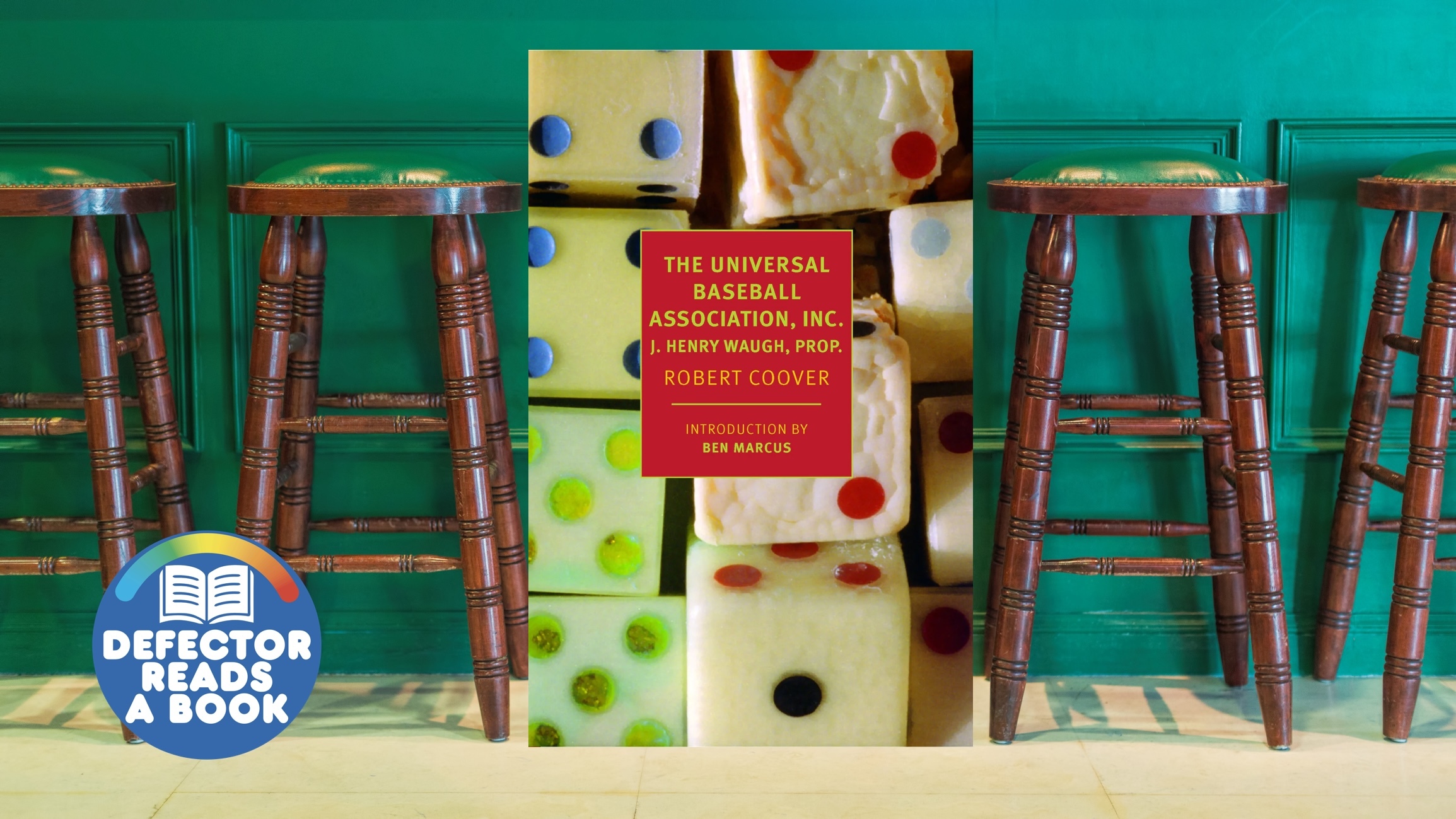
Photo · Defector
The Permission Structure
There's a version of every obsession that looks, from the outside, like a hobby. You keep a spreadsheet. You track numbers that don't affect anything. You build a small world with its own rules, its own seasons, its own dead. People who don't have one of these find it eccentric. People who do recognize it immediately as something closer to religion.
A writer at Defector has been sitting with Robert Coover's 1968 novel The Universal Baseball Association, Inc. J. Henry Waugh, Prop. — recently reissued by New York Review Books — and the piece they've written isn't really a review. It's a confession. It's the piece you write when a book finds you at exactly the right moment, when the sentences feel less like sentences and more like evidence of something you'd been trying to articulate for years. The writer describes a sentence structure so mesmerizing they couldn't put it down. They describe entering a rarified space from the first page. They describe picking it up knowing only that it was "about baseball" and discovering that it wasn't — not in any traditional sense.
What it's about, they say, is a version of baseball that exists only in the mind of its protagonist. A man named J. Henry Waugh, who runs a league that no one else can see.
The fact that this piece exists, right now, feels like its own kind of signal.
What Baseball Has Always Permitted
Baseball has a longer literary tradition than any other American sport, and I've always thought the reason isn't that the game is more poetic. It's that the game is slower. It gives you time to think about something else while you're watching it. The pauses are structural. The sport almost insists on interiority.
But Coover's novel, as described by this writer, does something more radical than use baseball as backdrop or metaphor. It uses baseball as a permission structure — the thing that makes it acceptable for a middle-aged accountant to spend his evenings rolling dice and populating an entire inner universe with players who live and die at the mercy of probability. The game isn't the point. The game is the excuse. What the novel is actually investigating, the Defector writer suggests, is what happens when the world you've invented starts to feel more real than the one you're living in — and what you do when those two worlds come into conflict.
That's not a baseball question. That's a human one. And it's one that 1968 was apparently asking, and 2025 is apparently still asking, loudly enough that New York Review Books decided to put the book back into print.
Strange Dice, Crumbling Edges
The writer notes that the NYRB reissue cover shows several misshapen dice with colorful dots and crumbling edges. It's a small detail, but it's the right one. Dice are the honest version of what we're all doing when we build private systems of meaning — acknowledging that chance is real, that outcomes aren't guaranteed, that the numbers can betray you. The crumbling edges suggest use. Suggest a person who has sat with this particular set of tools long enough to wear them down.
What strikes me about this piece isn't that someone found the novel profound. Plenty of people have, presumably, in the fifty-seven years it's been in the world. What strikes me is that the writer frames their discovery as almost accidental — they picked it up knowing almost nothing — and that the piece reads like someone reporting back from a country they didn't expect to find. The long, unwieldy title. The strange protagonist. The sentences you can't stop reading. There's a quality to the writing that suggests genuine surprise, and genuine surprise about a fifty-seven-year-old novel is interesting. It means the book is doing something that criticism hasn't flattened yet. It means there's still something in it that arrives fresh.
What We Build When We Can't Stop
The deeper subject here — the one the Defector piece is circling, even if it doesn't name it directly — is the question of what it means to tend something that doesn't need tending. J. Henry Waugh's baseball association doesn't require him. It's not real. The players don't need a manager. And yet he shows up, night after night, rolling dice, recording outcomes, caring about the results with a seriousness that the novel clearly does not treat as a joke.
There's something in that portrait that the writer at Defector found worth three thousand words of attention. I think I understand why. We live in a moment when the boundary between the world you inhabit and the world you construct has become genuinely difficult to locate. The tools for building private universes — detailed, populated, governed by rules you set — have never been more sophisticated or more available. The question Coover was asking in 1968 about one man with dice and a ledger is the same question anyone who has ever gotten lost in something asks eventually: at what point does the world inside become the world that matters?
The answer the novel apparently provides is complicated enough that a writer in 2025 needed to sit down and work through it in public. That's not nothing. That's the whole reason fiction survives.
Keep reading sports.

ESPN Named Him. Then Unnamed Him. Nobody's Explaining the Gap.
A retraction without a reckoning is just a deleted link.

Three People Died Celebrating. FIFA Hasn't Said Their Names.
Mexico City buried three people after the World Cup crowds came through. At some point, the sport has to sit with that.

Sell the Stadium, Lose the Room
NFL franchises are rolling out the welcome mat for World Cup tourists — and the desperation is showing.
From the other desks.

800 Horsepower, One Ton of Doubt
Lamborghini built the most powerful SUV it's ever made. It's also slower than what it replaced.

Gold Leaf on a Lacquer Dial, and the Weight of What That Costs
Awake's Frosted Leaf Royal Blue asks a question Vietnamese craft has never quite had to answer at this price.

Hide My Email Has Been Showing Your Email
Apple's privacy flagship has a hole in it. They've known for over a year.