Sergiño Dest Is 'Our Soil.' Someone Tell the Reporter Who Asked Where Bosnia Is.
The 2026 World Cup didn't create a new America. It just made the old one impossible to look away from.
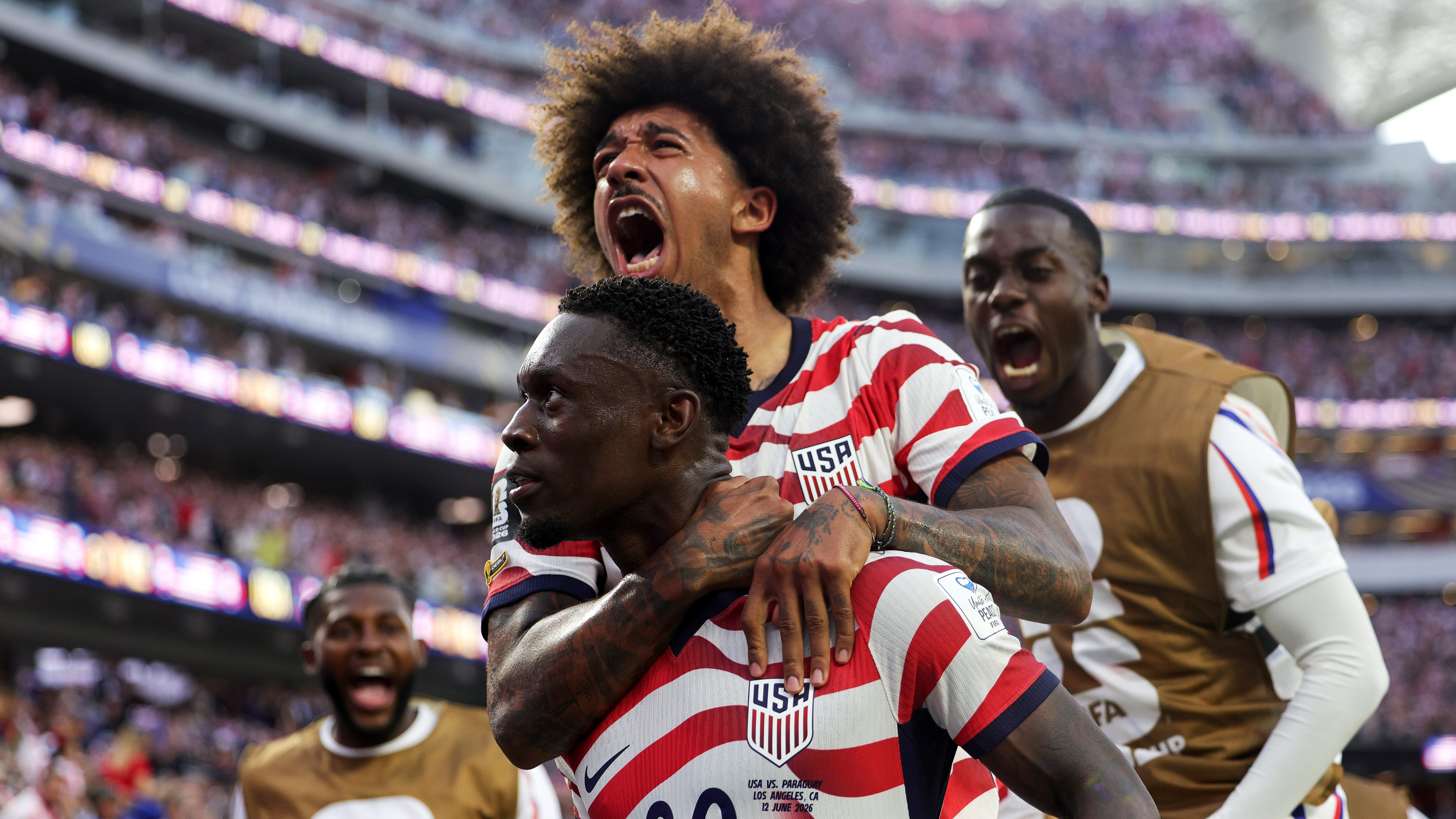
Photo · Andscape
The Post That Broke Something
Picture the image: three men celebrating a goal, arms wide, jerseys soaked, the particular ecstasy that only lives in a stadium at full roar. The Department of Homeland Security posted it. Chris Richards. Sergiño Dest. Folarin Balogun. The caption read "OUR SOIL." The Guardian noticed this. I noticed The Guardian noticing it, and then I sat with it for longer than I expected to, because there is something genuinely vertiginous about that image being deployed as a symbol of the very politics that would, in other contexts, treat those same men's stories with considerably less pride.
The 2026 World Cup is being played on American soil — in the literal sense, in American stadiums, in American cities — and it has become, almost despite itself, the most honest cultural document the country has produced in years. Not because anyone planned it that way. Because you can't hold a tournament this size, in a country this complicated, without the contradictions eventually wandering into frame.
Underdogs in Their Own House
Andscape went to Philadelphia and found Jean Claude Edwards and his daughter Tamikha walking back to their hotel after Haiti lost to Brazil in Group C. They were among the few thousand who showed up for that match. That detail — the few thousand, the walk back, the particular intimacy of a small crowd carrying a loss — stuck with me, because it captures something the television broadcast doesn't: that this World Cup contains multitudes that the camera doesn't always find.
The USMNT, meanwhile, is being framed as a baffling underdog. Baffling, because by most measures — resources, infrastructure, the sheer scale of American athletic machinery — they shouldn't be. And yet here they are, a team that opened group play with a 4-1 win over Paraguay and then lost to Türkiye, a team managed by Mauricio Pochettino, a team now preparing to face Bosnia and Herzegovina in the round of 32. Underdog status in your own country, hosted in your own stadiums, with a roster that looks like almost nowhere else on Earth. There's a specific American absurdity to that combination.
Pochettino, according to Deadspin's reading of events, may have delivered his fiery postgame press conference as a calculated move — a way of absorbing pressure, drawing attention to himself and away from his players. Whether that's true or not, the instinct is interesting: a manager choosing to be the story so his team doesn't have to be. That's a particular kind of leadership, and it implies a particular kind of fragility that he's trying to protect. A squad still finding itself. A country still figuring out what it wants this team to mean.
The Correspondent Who Didn't Want to Know
Then there was the ABC7 Los Angeles reporter. Wrapping a live shot from Long Beach after the USMNT's group-stage loss to Türkiye, she announced, with what Awful Announcing described as pride, that she didn't want to know anything about Bosnia and Herzegovina ahead of the round of 32 match. The clip went viral. Of course it did.
I don't want to make her the villain of a story that's bigger than her, but I do want to use that moment as a coordinate. Because it sits in almost perfect opposition to everything else happening around this tournament. You have a DHS post claiming Folarin Balogun as homeland. You have Haitian families in Philadelphia walking back from a Brazil loss. You have a roster whose surnames and backstories trace lines across three continents. And then you have a local television reporter, on air, declaring her ignorance of Bosnia as a kind of credential.
That's not stupidity. That's a reflex. The reflex that says: the world is complicated, and my audience isn't asking me to make it less so. Easier to frame the match as Us versus Some Country. The World Cup, in that reading, becomes a patriotism delivery system rather than what it actually is — which is, among other things, a story about where people come from and what they carry with them when they arrive somewhere new.
Who This Team Actually Is
The Guardian's broader analysis of the tournament put the USMNT's path in concrete terms: to win the whole thing, Pochettino's side would likely need to beat Spain, France, and England along the way. That's the mountain. Bosnia and Herzegovina first, then whatever the bracket produces, then eventually — if everything breaks right — a collision with the world's best.
It's a steep road. But what makes the USMNT interesting right now isn't the odds. It's the argument the roster makes just by existing. The DHS post was cynical, maybe, or at minimum oblivious to its own irony. But the irony only lands because the irony is real. Richards, Dest, Balogun — these are players whose presence on the team is a direct result of the kind of movement, migration, and hybrid identity that current American political discourse treats as a problem to be solved.
The team doesn't resolve that contradiction. It just refuses to pretend the contradiction isn't there.
I keep thinking about that walk in Philadelphia — Edwards and his daughter, a few thousand Haitian fans, a loss to Brazil, a hotel somewhere in the city. The World Cup contains that, too. Not just the ticker-tape moments. Not just the press conferences and the viral clips and the government social media accounts. It contains the people who show up for a team that probably won't win, in a country that doesn't entirely know what to do with them, because the game is theirs as much as anyone's.
That's not a feel-good story. It's just true. And in 2026, in America, true is harder to find than you'd think.
Keep reading sports.

ESPN Named Him. Then Unnamed Him. Nobody's Explaining the Gap.
A retraction without a reckoning is just a deleted link.

Three People Died Celebrating. FIFA Hasn't Said Their Names.
Mexico City buried three people after the World Cup crowds came through. At some point, the sport has to sit with that.

Sell the Stadium, Lose the Room
NFL franchises are rolling out the welcome mat for World Cup tourists — and the desperation is showing.
From the other desks.

800 Horsepower, One Ton of Doubt
Lamborghini built the most powerful SUV it's ever made. It's also slower than what it replaced.

Gold Leaf on a Lacquer Dial, and the Weight of What That Costs
Awake's Frosted Leaf Royal Blue asks a question Vietnamese craft has never quite had to answer at this price.

Hide My Email Has Been Showing Your Email
Apple's privacy flagship has a hole in it. They've known for over a year.