When Access Becomes the Story
Two newsrooms are investigating what happens when the line between source and subject disappears.
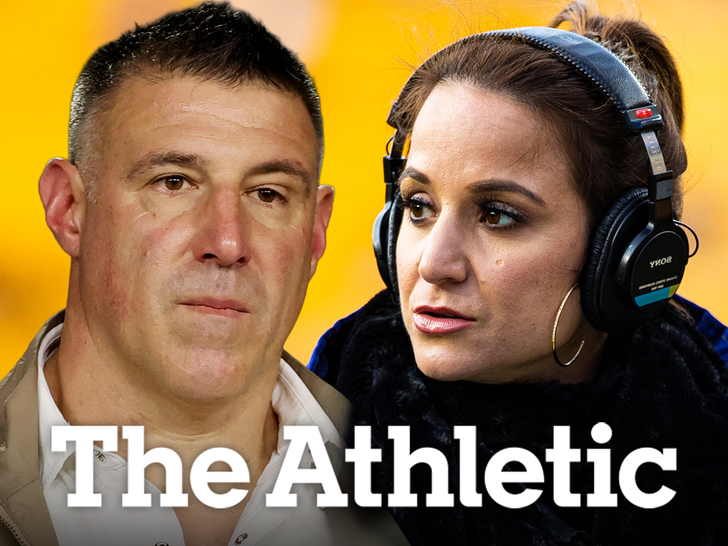
Photo · Front Office Sports
There's a version of this that looks fine on paper. A reporter knows a coach. They've covered him for years. They end up at the same resort. Photos exist. And then — suddenly — two of the most powerful sports journalism institutions in the country are investigating whether something crossed a line.
That's where Dianna Russini is right now.
The Access Economy, Exposed
Sports journalism runs on access. It always has. You get the story because you have the relationship. You have the relationship because you've protected it — been fair, been present, been trusted. That's not corruption. That's the job. But it is a system that only works when the relationship stays invisible, when the reader never has to wonder whose interests are actually being served.
Photos of Russini and New England Patriots head coach Mike Vrabel at an Arizona resort made that relationship visible. And once it's visible, the whole architecture of access journalism is suddenly under a spotlight it was never designed to survive.
The New York Times Company — which owns The Athletic — is now reviewing Russini's coverage of Vrabel, according to ESPN. She's been sidelined during that review. The Athletic, for its part, had already released a statement defending her before the review was announced. That's a notable sequence: defend first, investigate second. It suggests the institution moved to protect before it fully understood what it was protecting.
What Two Investigations Tell You
Front Office Sports reported that The Athletic itself is also probing the situation. So now you have two separate institutional reviews of the same reporter covering the same subject. That's not routine. That's an organization — and its parent company — trying to understand whether its own defenses were premature.
What neither investigation has concluded publicly, at least not yet, is whether anything actually compromised Russini's reporting. That distinction matters enormously and gets lost in the noise. There's a difference between the appearance of a conflict and an actual one. But in a media environment where trust is already scarce, the appearance is often enough to do the damage.
The irony is that this story isn't really about Russini. It's about a system that quietly tolerates deep personal familiarity between reporters and sources — until a photo surfaces and suddenly everyone pretends they didn't know how close it gets. Every major beat reporter in professional sports has relationships that would raise eyebrows if photographed at the wrong angle. That's not a defense of any individual situation. It's an acknowledgment that the industry has never seriously grappled with where access ends and compromise begins.
Institutions like The Athletic and The New York Times Company built their reputations on editorial independence. When that independence gets questioned — even by implication, even before any wrongdoing is established — the review isn't just about one reporter. It's about whether the business model of access journalism can survive its own contradictions.
The answer to that question is still being written. But the fact that it's being asked this loudly means the industry can't look away from it anymore.
Keep reading sports.

ESPN Named Him. Then Unnamed Him. Nobody's Explaining the Gap.
A retraction without a reckoning is just a deleted link.

Three People Died Celebrating. FIFA Hasn't Said Their Names.
Mexico City buried three people after the World Cup crowds came through. At some point, the sport has to sit with that.

Sell the Stadium, Lose the Room
NFL franchises are rolling out the welcome mat for World Cup tourists — and the desperation is showing.
From the other desks.

800 Horsepower, One Ton of Doubt
Lamborghini built the most powerful SUV it's ever made. It's also slower than what it replaced.

Gold Leaf on a Lacquer Dial, and the Weight of What That Costs
Awake's Frosted Leaf Royal Blue asks a question Vietnamese craft has never quite had to answer at this price.

Hide My Email Has Been Showing Your Email
Apple's privacy flagship has a hole in it. They've known for over a year.