The Calendar That Trusts You to Leave It Alone
Jaeger-LeCoultre's new perpetual calendar doesn't ask much of you — and that's the whole point.
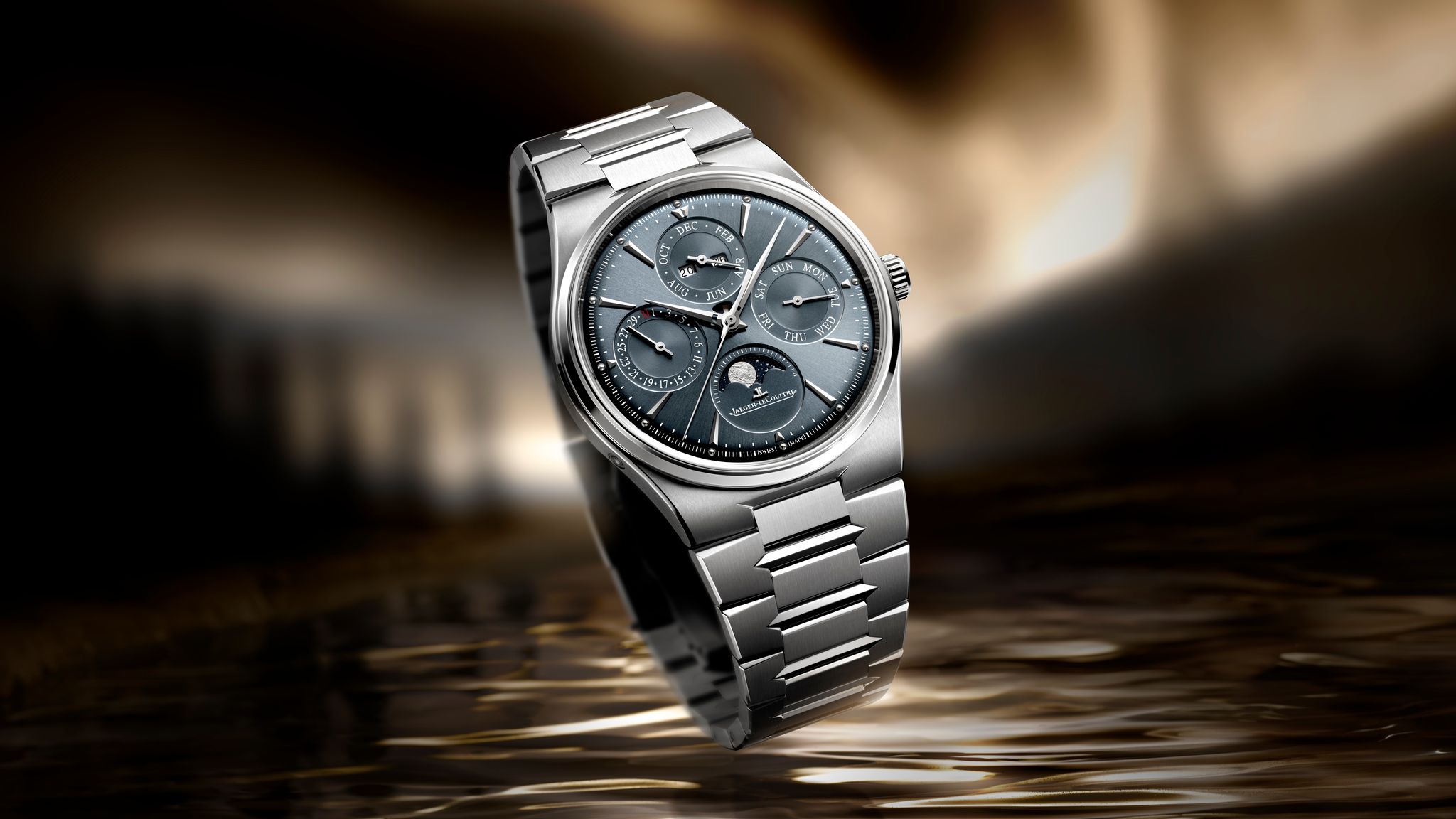
Photo · Style - Esquire
There's a certain kind of object that earns your trust quietly, over time, without demanding you notice it doing so. The 2026 Master Control Chronometre Perpetual Calendar is that kind of object.
Four sub-dials. Months and year sitting at 12 o'clock, days of the week at 3, dates at 9, and a moon phase at 6 — everything you'd want to know about time laid out with the unhurried logic of a well-organized room. Nothing competing. Nothing shouting. Just information, held in a 39mm case that measures 9.2mm thick, which is to say: barely there on the wrist.
The movement inside — Calibre 868 — is 4.72mm thick. Let that settle for a moment. The entire mechanical argument for a perpetual calendar, accounting for months of varying lengths and the irregular rhythm of leap years, compressed into less than five millimeters of engineering. It's the kind of number that sounds like a boast until you realize it's simply a fact.
What a Perpetual Calendar Actually Promises
The promise of a perpetual calendar is, at its core, a promise about trust. The watch knows what year it is. It knows February has 28 days most years and 29 occasionally. It will keep knowing, correctly, without you touching it, until 2100 — as long as it stays wound. That last clause is the only condition. A 70-hour power reserve gives you enough runway to take it off for a weekend without the whole arrangement collapsing.
And when you do need to make an adjustment — travel, a dead mainspring, a change of heart — all calendar indications correct simultaneously through a single corrector. Not four corrections for four sub-dials. One. The kind of decision that only gets made when the people designing something have actually thought about using it.
The Dial Is Doing Something
The steel version comes with a blue-grey gradient sunray dial, cool-toned and a little cinematic. The pink gold version answers with a warm bronze sunray. Both sub-dials carry an outer opaline ring and a central azuré finish — a layering of texture that only reveals itself in certain light, which is exactly the right amount of revelation for something this restrained.
The moon phase detail is where the piece lets itself go, just slightly. In the pink gold version, the moon is rendered in hammered 958/1,000 gold. In the steel version, platinum leaf at 999/1,000 purity. These aren't flourishes for a catalogue description — they're the kind of choices that make you look twice at your own wrist six months after you bought the thing.
Esquire noted that Jaeger-LeCoultre introduced an integrated bracelet across a trio of complications in this collection — a design shift worth registering. The bracelet and case reading as one continuous object changes the relationship between the watch and the wrist. It stops being something you're wearing and starts being something closer to an extension.
There's a version of watchmaking that wants you to feel the weight of its history every time you glance down. This isn't that. The Master Control Perpetual Calendar is more interested in being correct than being impressive — and somehow, that's the more impressive thing.
Keep reading fashion.

Gold Leaf on a Lacquer Dial, and the Weight of What That Costs
Awake's Frosted Leaf Royal Blue asks a question Vietnamese craft has never quite had to answer at this price.

Kyle Smith Has a Job Title That Didn't Exist Before. That's the Whole Tell.
When the NFL hires a fashion editor, it's not about clothes — it's about who gets to decide what matters.

525 Victories, One Dial, and Cycling's Long Wait for a Wrist
Breitling's Eddy Merckx edition doesn't just reference a legend — it asks whether motorsport's younger sibling has finally earned its place in serious watch culture.
From the other desks.

800 Horsepower, One Ton of Doubt
Lamborghini built the most powerful SUV it's ever made. It's also slower than what it replaced.

ESPN Named Him. Then Unnamed Him. Nobody's Explaining the Gap.
A retraction without a reckoning is just a deleted link.

Hide My Email Has Been Showing Your Email
Apple's privacy flagship has a hole in it. They've known for over a year.